
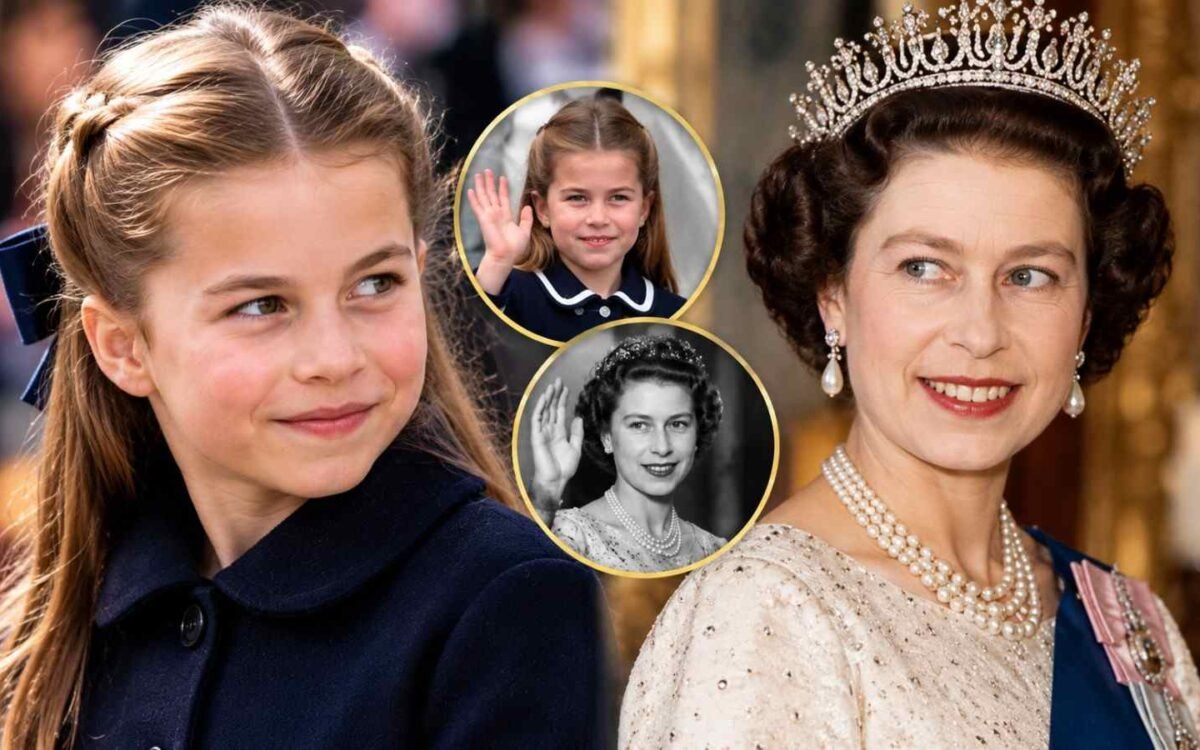
Princess Charlotte has become one of the most closely watched young members of the British royal family, and there is one comparison that continues to follow her wherever she goes: her late great-grandmother, Queen Elizabeth II.
From her facial features and expressions to her composed manner at major royal events, Charlotte has repeatedly reminded royal watchers of Britain’s longest-reigning monarch.
The comparisons have become particularly striking as Charlotte has grown older. While she clearly shares characteristics with several members of the Windsor family, many observers see something distinctly Elizabethan in the young princess.
And the similarities may extend beyond appearance.
Royal author Phil Dampier has previously said Charlotte inherited a remarkable ability to mimic prominent figures — a talent also associated with Queen Elizabeth II. Other reports have highlighted Charlotte’s maturity, poise and apparent love of horses, creating an increasingly fascinating connection between the two generations.
The Family Resemblance That Keeps Getting Attention
Princess Charlotte was born on May 2, 2015, to Prince William and Catherine, Princess of Wales.
From her earliest public appearances, royal fans began debating which member of the family she most resembled.
Some saw her father in her facial features. Others believed she looked remarkably like Catherine. And then there were those who immediately noticed similarities to Queen Elizabeth II.
As Charlotte has grown, the comparison has become even more common.
Photographs from royal occasions have repeatedly prompted discussions about her resemblance to her late great-grandmother, particularly around the eyes, smile and shape of her face.
One 2026 comparison even drew attention to photographs of Charlotte alongside archival images of the young Queen Elizabeth II.
But physical resemblance is only part of the story.
Charlotte’s Composure Is Another Reason for the Comparison
Queen Elizabeth II became famous for her ability to remain composed during some of the most demanding public moments of her reign.
Charlotte has shown a similar ability to remain remarkably calm during major royal occasions.
From Trooping the Colour to family appearances at Westminster Abbey and other major ceremonies, Charlotte has often appeared comfortable with the attention surrounding her.
That does not mean she has the same personality as her great-grandmother — something that cannot realistically be determined from public appearances alone.
But royal commentators have noticed the way Charlotte carries herself.
Royal author Phil Dampier previously compared Charlotte’s apparent maturity with that of Queen Elizabeth when she was young, noting that the future monarch had also been described as unusually mature for her age.
For a child growing up under constant public attention, that composure is particularly noticeable.
Read More – Prince William’s Relationship With Harry Faces Fresh Test as Princess Diana Anniversary Nears
Queen Elizabeth’s Remark About Charlotte and George
One of the most revealing connections between the two generations came directly from Queen Elizabeth herself.
In 2018, the late monarch reportedly made an observation about the relationship between Prince George and his younger sister Charlotte.
During a conversation with a family at Sandringham, Elizabeth was told about siblings who looked after one another. She reportedly replied that Charlotte and George had a similar dynamic, suggesting that Charlotte was the one who kept an eye on her older brother.
It was a remarkably personal observation from a monarch who was often careful about discussing family matters publicly.
The comment also helped establish something royal watchers had already noticed: Charlotte appeared confident and attentive despite being younger than George.
Charlotte Has a Special Place in the Royal Succession
There is another important connection between Charlotte’s generation and Queen Elizabeth’s legacy.
Charlotte is currently third in line to the British throne, behind her father, Prince William, and older brother, Prince George.
Her position is historically significant because she retained her place in the succession after the birth of her younger brother, Prince Louis.
That was made possible by the Succession to the Crown Act 2013, which ended the traditional preference for male heirs over older female siblings in the British line of succession.
In other words, Charlotte’s position represents a modern change that took place during Queen Elizabeth II’s reign.
She therefore embodies an interesting combination of royal tradition and constitutional change.
Her Name Carries Two Major Royal Connections
Charlotte’s full name also contains an important link to the previous generation.
She is Princess Charlotte Elizabeth Diana.
“Elizabeth” honours her great-grandmother, Queen Elizabeth II, while “Diana” honours her late grandmother, Diana, Princess of Wales.
That combination gives Charlotte a unique place within the family’s recent history.
Her name connects three generations of the royal family: Queen Elizabeth II, Princess Diana and the future generation represented by Charlotte herself.
The name was carefully chosen, and the Elizabeth connection became even more meaningful following the Queen’s death in 2022.
A Shared Love of Horses
One of the more personal similarities between Charlotte and Queen Elizabeth is their reported interest in horses.
Queen Elizabeth II was one of the world’s best-known royal equestrian enthusiasts.
Horses were an important part of her life from childhood, and her passion for breeding and racing remained a lifelong interest.
Charlotte has also been associated with riding and an interest in horses from a young age.
That shared enthusiasm provides a connection that goes beyond photographs.
In 2026, attention was also drawn to Charlotte wearing a diamond horseshoe brooch that had been given to her by Queen Elizabeth.
She wore the piece during significant royal occasions, including the Queen’s funeral and Trooping the Colour, turning it into a subtle tribute to her great-grandmother.
The jewellery is particularly meaningful because the horseshoe motif connects directly to the Queen’s lifelong passion for horses.
Charlotte May Have Inherited an Unexpected Talent
The comparisons become even more interesting when personality and family anecdotes enter the discussion.
According to royal author Phil Dampier, Charlotte has inherited an impressive ability to imitate prominent figures.
That talent reportedly mirrors Queen Elizabeth’s own ability to perform impressions.
The late Queen was known among family and friends for her sense of humour and ability to imitate politicians and other public figures.
Dampier suggested that Charlotte’s talent could provide plenty of entertainment during family gatherings.
It is one of those lesser-known family similarities that offers a more personal picture of Charlotte.
The public usually sees her during formal royal appearances, but stories about her sense of humour suggest there may be a much more playful personality behind the composed public image.
But Charlotte Is Also Very Much Her Mother’s Daughter
While the Queen Elizabeth comparison gets the most attention, Charlotte is not simply a “mini Queen.”
Recent observations have also highlighted similarities between Charlotte and Catherine, Princess of Wales.
Her style, expressions and mannerisms are frequently compared with those of her mother.
During royal appearances, the two have sometimes appeared coordinated in their clothing and presentation, while Charlotte’s growing confidence has also been associated with Catherine’s calm public presence.
That combination makes Charlotte’s appearance particularly interesting.
She may have inherited physical characteristics from several branches of the Windsor family while developing her own personality.
Her Relationship With Queen Elizabeth Was Brief but Meaningful
Charlotte was born in 2015, meaning she spent only seven years with her great-grandmother before Queen Elizabeth died in September 2022.
Even so, the young princess was old enough to have memories of the late monarch.
Charlotte attended the Queen’s funeral alongside her parents and brothers, becoming one of the youngest members of the royal family to take part in the historic occasion.
Her presence attracted considerable attention because of her age and the significance of the event.
She was not simply attending as another member of the royal family.
She was saying goodbye to a great-grandmother who had reigned for seven decades.
A Quiet Link Between Two Generations
Perhaps the most fascinating aspect of the Charlotte-Elizabeth comparison is that it represents continuity within the royal family.
Queen Elizabeth II represented an entire era of British history.
Charlotte belongs to a generation growing up in a very different monarchy.
Prince William and Catherine have sought to give their children a childhood that includes ordinary family experiences alongside royal responsibilities.
The monarchy itself is also changing.
Yet when Charlotte appears at a major ceremony, observers sometimes see echoes of the young Elizabeth — a calm expression, a formal posture or an ability to remain focused while surrounded by crowds.
Those comparisons are naturally subjective.
A photograph can capture a resemblance, but it cannot tell us exactly what a child’s personality will become.
Charlotte’s Future Will Be Very Different From Elizabeth’s
It is also important not to assume that Charlotte’s future will simply replicate her great-grandmother’s.
Queen Elizabeth became heir presumptive at a young age and eventually became monarch following the death of her father, King George VI.
Charlotte is currently third in line to the throne.
Unless circumstances change dramatically, her future role will be very different.
Her position is more likely to involve supporting the monarch and the heir rather than eventually becoming queen herself.
That could make her relationship with Prince George especially important.
Queen Elizabeth’s own relationship with her sister Princess Margaret demonstrated how royal siblings could occupy very different constitutional roles while remaining important parts of the monarchy.
Charlotte may eventually find herself performing a similarly supportive role within a future royal generation.
Why Royal Watchers Continue to Notice Her
Charlotte’s public appearances remain relatively limited compared with adult working royals.
That makes every major appearance more closely watched.
When she appears alongside William, Catherine, George and Louis, photographers inevitably capture moments that fuel discussions about which relative she resembles.
Sometimes it is her mother.
Sometimes her father.
Sometimes Princess Diana.
And increasingly, Queen Elizabeth II.
The fact that so many different family comparisons are made may ultimately be evidence that Charlotte carries characteristics from several branches of her family.
Charlotte’s Story Is Still Only Beginning
At just 11 years old, Princess Charlotte has many years before her eventual role within the Royal Family becomes clear.
For now, the comparisons with Queen Elizabeth remain observations rather than predictions.
Her facial resemblance is subjective. Her mannerisms will continue to change. Her interests will develop. And her personality will become increasingly distinct as she grows older.
But the connection with her late great-grandmother is already part of Charlotte’s public story.
She shares a family name with Elizabeth.
She has been linked to the late Queen through horses and royal heirlooms.
She has been praised by commentators for a level of maturity reminiscent of the former monarch.
And she may even have inherited Elizabeth’s talent for making people laugh through impressions.
More Than Just a Look-Alike
The fascination with Princess Charlotte and Queen Elizabeth II ultimately goes beyond whether two photographs look similar.
It is about the possibility of continuity within a family that has undergone enormous change.
Queen Elizabeth spent 70 years adapting the monarchy to a changing world.
Charlotte is growing up in another period of transition, with her father preparing for the throne and her brother destined to become king.
Whether she eventually develops the same sense of duty associated with her great-grandmother is impossible to know.
But one thing is already clear: Princess Charlotte has inherited a remarkable royal legacy, and the comparisons with Queen Elizabeth II are unlikely to disappear anytime soon.
1 comment