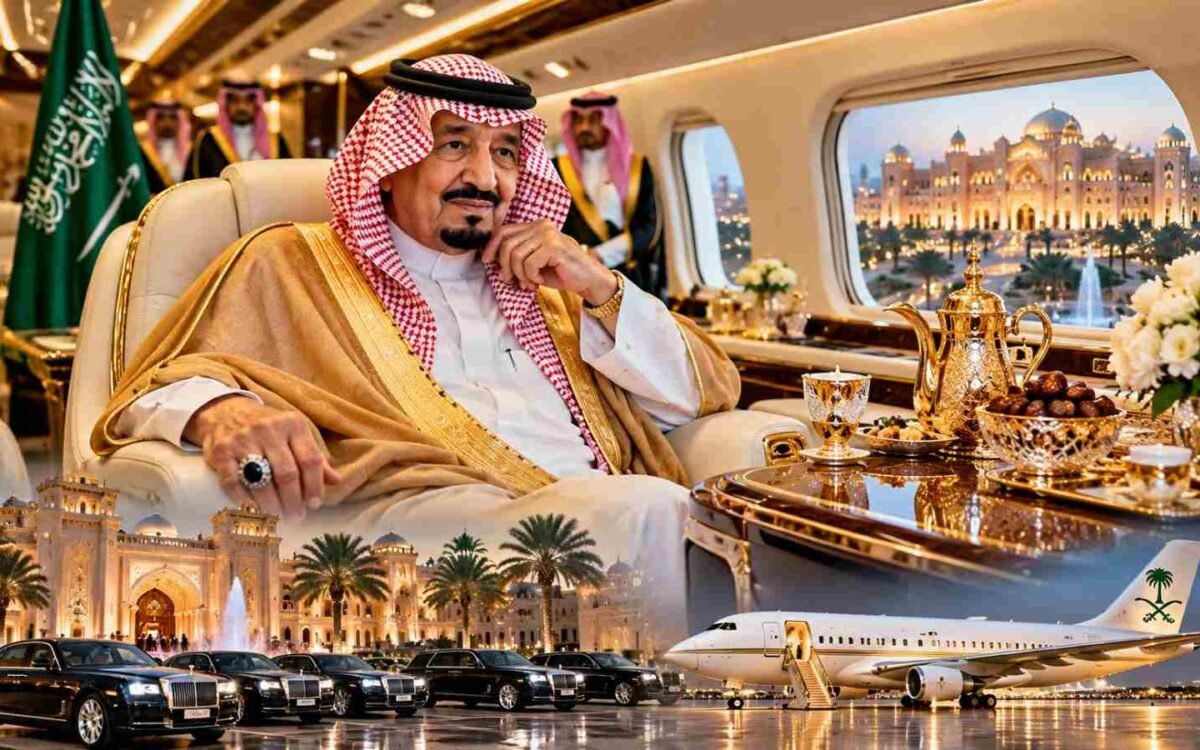
King Salman bin Abdulaziz Al Saud, the monarch of Saudi Arabia, is associated with extraordinary wealth, royal luxury and one of the world’s most influential ruling dynasties. With Saudi Arabia’s vast oil resources and the enormous financial power of the House of Saud, questions about the king’s personal fortune and spending habits continue to fascinate readers around the world.
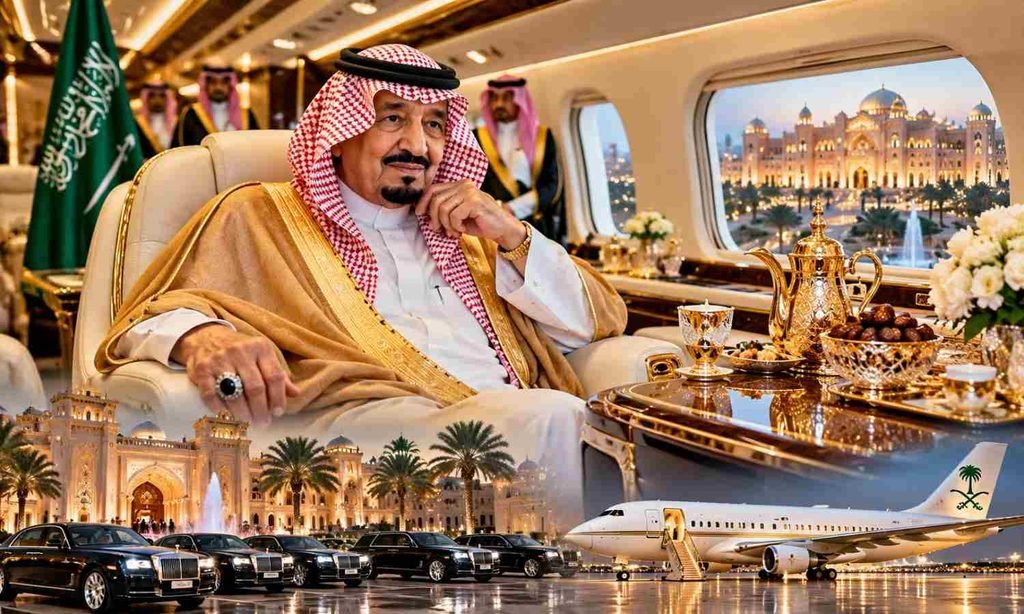
Some online headlines have attached a staggering $2 trillion figure to King Salman. However, that number requires important context. The king’s personal wealth is not publicly verified at that level, and the financial resources of Saudi Arabia, its sovereign investment funds and the wider royal family cannot simply be treated as his personal bank account.
Estimates from celebrity-finance publications have placed King Salman’s personal fortune around $18 billion to $20 billion, but these figures remain estimates rather than independently audited disclosures.
So how does the Saudi monarch’s wealth fit into the country’s vast financial system? From royal residences and luxury travel to private assets and the wider economic power of the House of Saud, the story offers a glimpse into a world where personal fortune, political influence and national resources are often discussed together.
1. Understanding King Salman’s Reported Fortune
King Salman became Saudi Arabia’s monarch in January 2015, following the death of his half-brother, King Abdullah. Before ascending the throne, he spent decades in public service, including a lengthy period as governor of Riyadh Province.
His position places him at the centre of a country whose economy has historically depended heavily on oil production and exports. Saudi Arabia is also home to major state-controlled enterprises, extensive infrastructure projects and a sovereign investment fund with international holdings.
These factors help explain why estimates of Saudi royal wealth can reach enormous figures. However, the king’s personal assets must be distinguished from the financial resources controlled by the Saudi state.
Estimates of King’s Salman’s personal net worth vary, and there is no publicly available, independently audited statement establishing the exact value of his holdings. His true personal fortune therefore remains uncertain.
The headline figure of $2 trillion should not be treated as a confirmed personal net worth. Understanding that distinction is essential before examining the luxury and financial influence associated with the Saudi monarchy.
2. Royal Palaces and Lavish Residences
Royal residences are among the most visible symbols of the Saudi monarchy’s wealth and status. Saudi Arabia’s royal family has access to grand residences, formal reception spaces and properties used for official events and private life.
Such buildings serve more than one purpose. They can accommodate royal households, host visiting dignitaries, support official ceremonies and provide settings for meetings with political leaders.
The scale and presentation of royal residences reflect the ceremonial responsibilities of a monarchy that maintains relationships with governments, business leaders and international institutions.
However, not every palace associated with the Saudi royal family is personally owned by King Salman, and the public does not have a complete inventory of his private property. Some residences may serve official or institutional purposes rather than function as personal assets.
This distinction matters because the value of a royal residence does not automatically count toward an individual’s personal net worth.
3. Luxury Travel and the Royal Lifestyle
International travel is an important part of modern diplomacy, particularly for leaders of countries with significant economic and geopolitical influence.
The Saudi monarch’s official travel arrangements may involve specialised aircraft, security personnel, logistical support and teams responsible for coordinating meetings and ceremonial visits.
These arrangements can be extensive because international visits require more than transportation. They may involve secure communications, accommodation, advance planning and coordination with host governments.
Saudi Arabia’s royal establishment is known for operating on a scale that reflects the country’s resources and diplomatic ambitions. Yet the cost of official travel should not automatically be described as the king’s personal spending.
Aircraft used for official purposes, state-funded security and diplomatic logistics may be financed through public or institutional budgets. Without reliable financial records, it is not possible to determine precisely how much King Salman personally spends on luxury travel each year.
The broader picture is one of a royal institution supported by substantial resources, with a clear distinction between official expenditure and personal consumption.
4. Private Assets, Investments and Royal Family Wealth
The House of Saud is one of the world’s most prominent ruling dynasties, and members of the wider family have accumulated wealth through inheritance, investments and business interests.
Some royal family members have publicly documented commercial holdings, while others have financial arrangements that are difficult to assess from public information.
This creates a challenge for anyone attempting to calculate the total wealth of the dynasty. The combined resources of thousands of family members cannot be reliably assigned to one individual.
Personal investments can include property, corporate stakes and other financial assets. However, claims about specific portfolios or the value of individual holdings require reliable documentation.
For King Salman, the available public information does not provide a comprehensive account of every private asset, investment or financial obligation. Consequently, published estimates should be treated as approximations rather than definitive valuations.
The distinction between individual wealth and collective family wealth is especially important when discussing figures in the hundreds of billions or trillions of dollars.
5. Saudi Arabia’s Oil Wealth: The Foundation of Its Economic Power
Oil has played a central role in Saudi Arabia’s economic development and international influence. Revenue from energy exports has supported public finances, infrastructure, industrial development and investment over many decades.
Saudi Aramco, the country’s major oil company, is one of the most significant energy businesses in the world. Its economic importance helps explain why Saudi Arabia is often associated with extraordinary financial power.
Read More- Prince Harry and Meghan’s UK Future After Nottingham Visit
However, the company’s revenues and the government’s oil income are not the same as King Salman’s personal earnings.
Oil revenue enters a wider economic and fiscal system. Government expenditure, investment, public services and national development priorities all form part of that system.
The monarchy’s position gives it an important role in the country’s political and institutional structure, but political authority over national resources does not make those resources personal property.
This is one of the main reasons that estimates of Saudi royal wealth can be misleading when they combine state assets, family holdings and personal fortunes into one headline number.
6. The Public Investment Fund and the $2 Trillion Question
Saudi Arabia’s Public Investment Fund, commonly known as the PIF, is a central part of the country’s economic diversification strategy.
The fund invests in businesses, infrastructure and projects in Saudi Arabia and overseas. Its mandate is connected to the kingdom’s broader efforts to reduce its dependence on oil and develop sectors such as tourism, technology, entertainment and advanced industry.
The PIF has also been associated with ambitious growth targets. In 2016, Crown Prince Mohammed bin Salman discussed an ambition to build the fund into a $2 trillion global investment vehicle.
That historical target helps explain why the $2 trillion figure appears so frequently in discussions of Saudi wealth. It was an investment ambition for a state fund—not proof that King Salman personally possessed $2 trillion.
The fund’s assets belong to the institution and are managed for its designated purposes. They should not be counted as the monarch’s personal bank balance simply because the fund operates within the Saudi political system.
Understanding the PIF is therefore essential to separating the kingdom’s financial ambitions from claims about the king’s private fortune.
7. Vision 2030 and the Kingdom’s Spending Priorities
Saudi Arabia’s Vision 2030 programme aims to diversify the national economy, expand non-oil industries and create new opportunities in areas such as tourism, culture, sport, entertainment and technology.
The programme has encouraged investment in major development projects, new destinations, transport infrastructure and initiatives intended to attract international businesses and visitors.
These projects can involve enormous budgets, but they are part of a broader national development strategy rather than direct evidence of the monarch’s personal spending.
Crown Prince Mohammed bin Salman has been the principal public figure associated with Vision 2030 and the expanded role of the Public Investment Fund. King Salman remains the country’s monarch, while the crown prince has taken a leading role in economic policy and government administration.
The programme illustrates how Saudi financial power is deployed across different priorities. Some spending supports economic transformation, some is associated with government operations, and some involves investments expected to generate future returns.
For readers interested in royal wealth, the key question is not simply how much money Saudi Arabia possesses, but how the country’s resources are owned, managed and spent.
8. Why It Is Difficult to Calculate the King’s Exact Net Worth
Calculating the personal wealth of a public-company executive is often possible because company filings, shareholdings and other financial disclosures provide measurable information.
Assessing the personal fortune of a monarch can be more difficult, particularly when complete financial disclosures are unavailable.
In Saudi Arabia’s case, the public record does not provide a fully audited breakdown of King Salman’s personal property, investments, cash holdings and liabilities.
Estimates published by wealth websites may draw on incomplete information or assumptions about royal assets. Different sources can therefore produce different figures, and their methodologies are not always transparent.
There is also the risk of double counting. An investment owned by a state fund should not be counted again as a personal asset of the monarch unless evidence establishes that he personally owns it.
For these reasons, a responsible assessment should distinguish between verified information, published estimates and speculation.
The exact value of King Salman’s personal fortune remains unconfirmed, and the $2 trillion figure should not be presented as an established fact about his private wealth.
9. King Salman’s Wealth Compared With Other Global Fortunes
King Salman’s reported wealth is often discussed alongside the fortunes of billionaires, business leaders and other royal families.
However, comparisons can become misleading when the underlying figures measure different things.
A billionaire’s estimated net worth generally reflects personal assets minus liabilities. A sovereign wealth fund’s assets under management represent the value of investments held by an institution. A country’s gross domestic product measures economic output over a period of time, not the amount of money owned by its ruler.
These measures are not interchangeable.
Saudi Arabia’s national economic resources are enormous, and members of the royal family may hold substantial personal fortunes. But neither fact establishes that the king personally owns the entire value of the country’s oil industry, investment funds or economy.
The most accurate comparisons therefore focus on clearly defined categories of wealth and acknowledge the uncertainty surrounding privately held assets.
10. The Difference Between Personal Luxury and Public Responsibility
The lifestyle associated with a monarchy often attracts attention because it can appear very different from the daily lives of ordinary citizens.
Royal residences, formal ceremonies, security arrangements and diplomatic travel can all involve significant resources. At the same time, a monarch’s public role includes official responsibilities that are distinct from private leisure.
The financial arrangements behind these activities are not always publicly itemised. It is therefore difficult to calculate exactly how much King Salman personally spends on luxury goods, private travel or property maintenance.
A careful account should avoid inventing annual spending figures or assigning every royal expense to the king personally.
The broader issue is how wealth, public authority and national resources intersect within a hereditary monarchy. That question extends beyond one individual’s lifestyle and into the institutions that manage Saudi Arabia’s economy.
Conclusion: King Salman’s Fortune Is Enormous, but the $2 Trillion Claim Needs Context
King Salman presides over a country with extraordinary energy resources, a powerful royal dynasty and a growing international investment presence. His personal fortune has been estimated in the tens of billions of dollars, but its exact value has not been publicly verified.
The frequently repeated $2 trillion figure should not be confused with his personal net worth. It is more closely associated with discussions of Saudi Arabia’s wider economic resources and historical ambitions for the Public Investment Fund.
Royal residences, official travel and private assets all form part of the wider discussion about the Saudi monarchy’s wealth. Yet public evidence does not provide a complete breakdown of the king’s personal spending or establish that every asset linked to the monarchy belongs to him individually.
The most revealing aspect of the story is therefore not a single eye-catching number. It is the distinction between the fortune of an individual monarch, the collective wealth of a royal dynasty and the vast financial resources of a modern oil-producing state.