
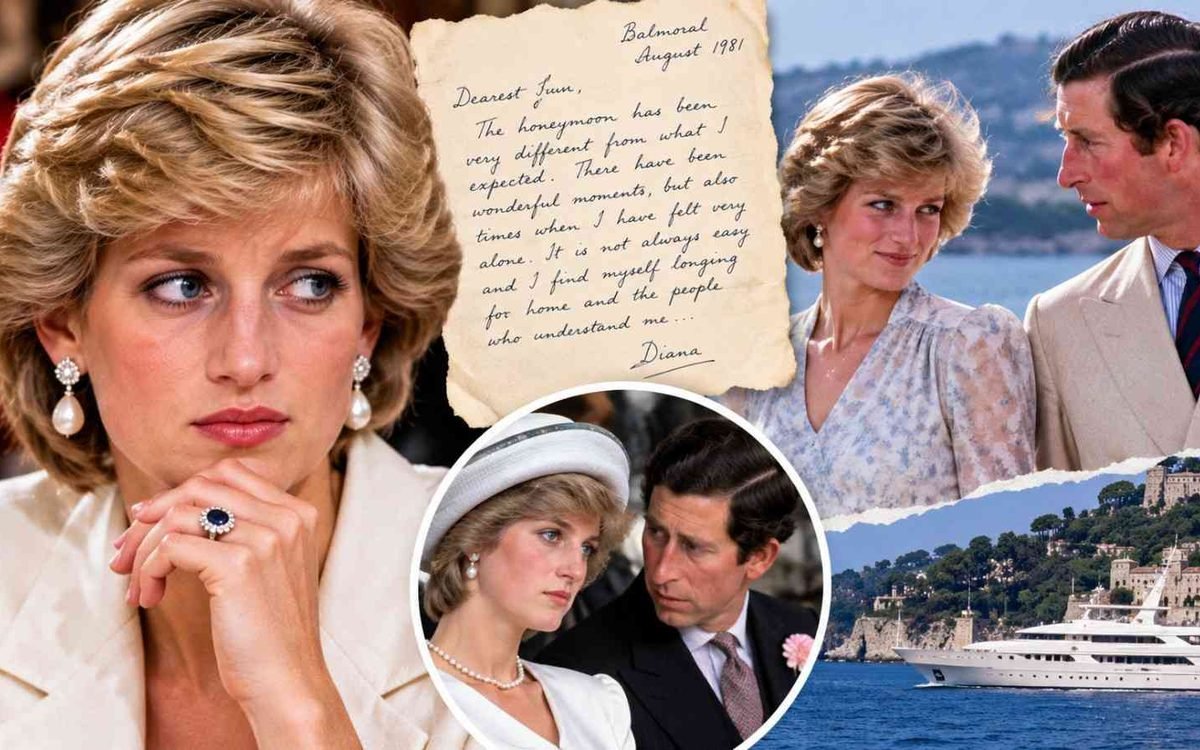
A handwritten letter from Princess Diana has offered a fascinating glimpse into the early days of her marriage to Prince Charles, revealing a surprisingly cheerful description of their honeymoon just weeks after their celebrated royal wedding.
Written on September 27, 1981, the three-page letter was addressed to Diana’s childhood friend Katherine Hanbury. In it, the young princess described the honeymoon as “blissful,” shared her enthusiasm for spending time outdoors in Scotland and reflected positively on being newly married.
The letter is attracting renewed attention because it captures a moment in Diana’s life long before her marriage became associated with public heartbreak, separation and controversy. Yet the correspondence also raises an important question: how did the hopeful young bride who wrote so warmly about married life come to describe a very different emotional reality in later years?
What Princess Diana Wrote About Her Honeymoon
Diana’s letter provides a personal account of her first weeks as a married woman. Writing to a friend she had known since her schooldays, she expressed gratitude for a card and shared a few details about life after the wedding.
Describing the honeymoon, Diana wrote that it had been “blissful,” with plenty of sunshine and calm seas. Her message suggested that at least some aspects of the newlywed experience had been enjoyable.
The couple had married on July 29, 1981, in a ceremony at St Paul’s Cathedral that attracted enormous international attention. Their honeymoon included a Mediterranean cruise aboard the Royal Yacht Britannia before they travelled to Balmoral, the Royal Family’s Scottish residence.
By the time Diana wrote to Hanbury, the couple were in Scotland, where they planned to remain until the end of October.
Diana appeared particularly enthusiastic about the setting. She wrote that being in Scotland was a treat because she loved spending the day outdoors and disliked London.
The informal tone of the letter offers a contrast to the carefully managed public image surrounding the royal wedding. Instead of addressing the nation or speaking to reporters, Diana was writing privately to a friend and sharing ordinary observations about her new life.
Read More- Queen Camilla Opens Up About King Charles’s Cancer Diagnosis
‘It’s Wonderful Being Married’: Diana’s View of Her New Life
One of the most striking passages in the letter concerns Diana’s feelings about marriage itself.
Writing after approximately two months as a newlywed, she described married life in positive terms. Her words conveyed the excitement of someone still adjusting to a major personal change.
The letter also included a revealing comment about her new position within the Royal Family. Diana described the experience as a case of “playing grown ups,” a phrase that suggested she was navigating an unfamiliar world of adult expectations and responsibilities.
Diana was only 20 when she married Charles, who was 32 at the time. Her transition from a young woman outside the immediate royal spotlight to the wife of the heir to the British throne was an extraordinary change.
The private note offers a glimpse of how she communicated with people who had known her before royal life transformed her circumstances.
However, a single letter cannot tell the whole story of a marriage. Its value lies in recording what Diana chose to share with a friend at that particular moment, rather than providing a complete account of her feelings or the relationship.
Why the Letter Contrasts With Diana’s Later Recollections
The renewed interest in the letter stems partly from the contrast between its upbeat description of the honeymoon and Diana’s later accounts of the difficulties she experienced during the early stages of her marriage.
In interviews and recordings used by biographer Andrew Morton for Diana: Her True Story, Diana described feeling distressed by Charles’s continuing emotional connection with Camilla Parker Bowles. She also recalled moments during the honeymoon when she felt troubled by reminders of that relationship.
Those later recollections have shaped much of the public understanding of the marriage’s early difficulties.
The newly highlighted letter does not automatically disprove those accounts. People can experience happy moments alongside anxiety, insecurity or conflict, particularly during a major life transition. A person may also describe an experience differently depending on the audience, the timing and what they feel comfortable sharing.
The letter and Diana’s later testimony therefore provide different perspectives on a complicated period of her life.
Rather than treating one account as the definitive truth and the other as false, it is more accurate to recognise that both contribute to a broader understanding of Diana’s experiences.
A Young Princess Adjusting to Royal Expectations
The comment about “playing grown ups” may be one of the most revealing details in the correspondence.
Diana had entered an institution defined by tradition, public scrutiny and demanding expectations. Her wedding was watched by millions, and her position as Charles’s wife meant that even her private life attracted extraordinary interest.
Yet the letter’s references to outdoor activities, friendship and everyday pleasures suggest that she continued to value familiar comforts.
Her enthusiasm for Scotland also provides a glimpse of the environment in which she was spending the early weeks of her marriage. Balmoral was a traditional setting for the Royal Family’s private summer and autumn gatherings, away from the constant attention surrounding official London engagements.
For Diana, who had grown up in the British countryside, the opportunity to spend time outdoors may have been especially welcome.
The correspondence does not explain everything she was experiencing as a new member of the Royal Family. Nevertheless, it preserves a small, personal moment from a period that would later become the subject of extensive public discussion.
The Story Behind Diana’s Rare Handwritten Letter
The letter was part of a collection of personal material belonging to Katherine Hanbury, Diana’s former school friend. The archive also included a handwritten birthday card, photographs from Diana’s schooldays and a programme connected to a memorial service held after her death.
The three-page correspondence was written on royal stationery and accompanied by its original envelope. Its provenance links it to someone who knew Diana before her marriage made her one of the most recognisable women in the world.
The wider collection offers a more personal view of Diana than the familiar photographs of royal ceremonies and public appearances.
School photographs, birthday greetings and letters can reveal the friendships and everyday connections that existed beyond official royal life. They also help historians and biographers place famous individuals within the ordinary relationships that shaped their earlier years.
The letter’s importance is therefore not limited to its description of the honeymoon. It is also a surviving piece of personal correspondence from a woman whose life was documented intensely but whose private experiences were often difficult to reconstruct fully.
Princess Diana’s Marriage to Charles Would Take a Different Turn
Diana and Charles’s marriage ultimately faced serious difficulties. The couple separated in 1992 and divorced in 1996, after years of public and private strain.
Diana spoke openly in later years about the pressures she experienced, including the complications surrounding Charles’s relationship with Camilla. Her accounts helped reshape public understanding of a marriage that had initially been presented as a royal fairytale.
Diana died in a car crash in Paris on August 31, 1997, at the age of 36. Her legacy has continued to inspire widespread interest in her life, her charitable work and her relationship with the monarchy.
Against that history, a letter describing a “blissful” honeymoon can seem surprising. But it is important not to interpret it as proof that the marriage was entirely happy, just as later accounts of distress should not erase every positive experience she may have had.
The correspondence records a moment in time, before the full story of the relationship had become clear to the public.
What the Letter Really Tells Us About Princess Diana
Princess Diana’s handwritten message is compelling because it offers a glimpse of the young woman behind the royal image. Her words reflect gratitude toward a friend, enjoyment of the Scottish countryside and optimism about a new chapter in her life.
At the same time, the letter reminds us of the limits of historical documents. A private message can reveal genuine feelings without capturing every emotion or event that surrounded its author.
The contrast between Diana’s early description of married life and her later recollections makes the letter particularly significant. It encourages a more nuanced view of her relationship with Charles, one that acknowledges the changing nature of their experiences rather than reducing their marriage to a single narrative.
Ultimately, the letter preserves something rare: Diana’s own words from the beginning of her royal marriage. Decades later, they offer a personal snapshot of a young princess still finding her place in an unfamiliar world—and a reminder that even the most closely watched lives are more complicated than their public stories suggest.

1 comment