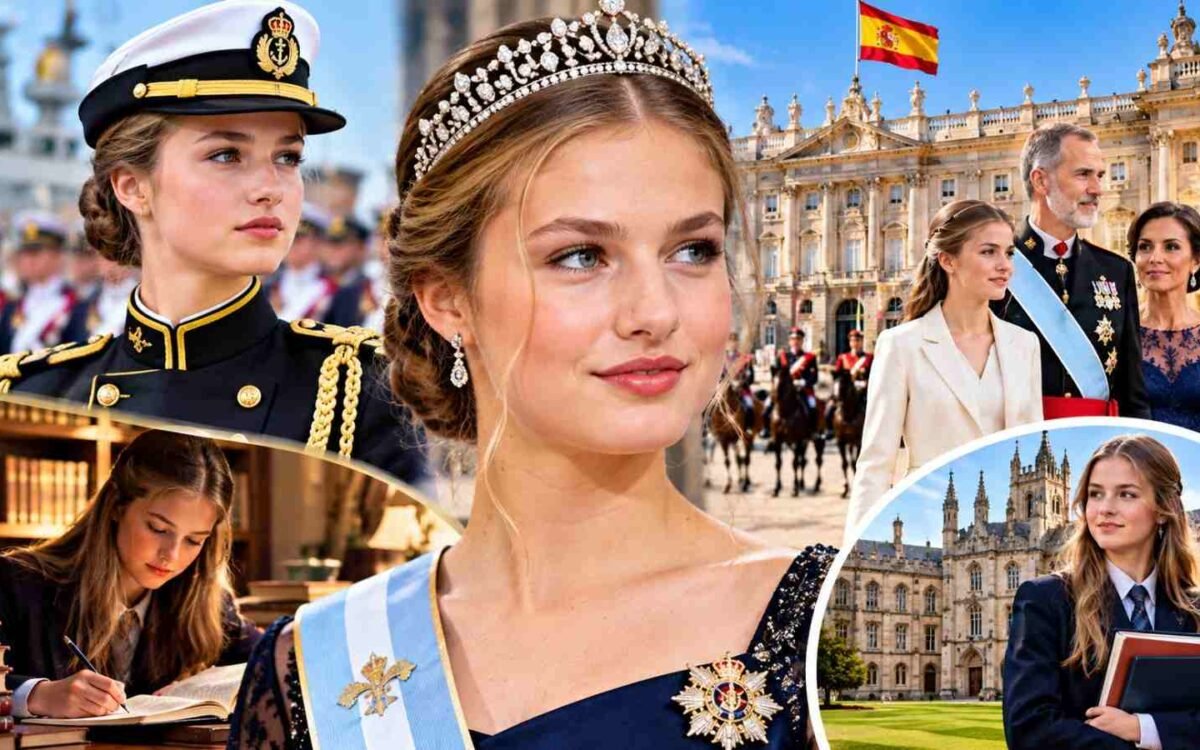
Princess Leonor of Spain has grown up surrounded by royal tradition, historic palaces and the responsibilities of one of Europe’s most prominent monarchies. As the eldest daughter of King Felipe VI and Queen Letizia, she is the heir to the Spanish throne and is being prepared for a future role that will place her at the centre of the country’s constitutional monarchy.
Her privileged position has naturally sparked curiosity about her personal fortune, lifestyle, education and access to royal wealth. Online discussions sometimes describe Leonor as a billionaire princess, but there is no publicly verified figure establishing her personal net worth at that level.
The reality is more complicated. Spain’s monarchy has access to official funding, historic royal properties and institutional resources, but these should not be confused with Leonor’s personal assets. Her life combines the advantages associated with royal status with formal education, military training and growing public responsibilities.
From her royal residences and carefully planned education to her journey toward becoming queen, here is a closer look at Princess Leonor’s wealth, lifestyle and future.
1. Who Is Princess Leonor of Spain?
Princess Leonor de Borbón y Ortiz was born in Madrid on 31 October 2005. She is the elder daughter of King Felipe VI and Queen Letizia and the older sister of Infanta Sofía.
Leonor became heir to the Spanish throne when her father was proclaimed king on 19 June 2014. She holds the title Princess of Asturias, traditionally associated with the heir to the Spanish Crown, as well as several other historic titles.
Her position gives her a prominent place in Spain’s public life. She attends official ceremonies, participates in significant national events and represents the next generation of the monarchy.
Unlike a celebrity whose public profile is built around entertainment or commercial endorsements, Leonor’s role is connected to constitutional responsibilities and preparation for future public service.
Her royal position provides access to resources and opportunities that most people do not experience. However, that privilege does not mean that every palace, investment or asset associated with the Spanish monarchy belongs to her personally.
2. Is Princess Leonor a Billionaire?
One of the most frequently asked questions about Princess Leonor concerns her net worth.
Despite online headlines suggesting that she belongs to the billionaire class, no official disclosure confirms that she personally owns billions of euros or dollars. The Royal Household does not publish a verified personal balance sheet for Leonor, and estimates circulating on celebrity-finance websites should not be treated as established facts.
Understanding the difference between royal wealth and personal wealth is essential.
A monarch’s household may use official funding for staff, travel, ceremonies and institutional responsibilities. Historic palaces and other properties may be maintained by public institutions. State-owned companies and sovereign investments also have their own legal and financial structures.
None of these resources automatically becomes the personal property of the heir to the throne.
Princess Leonor’s precise personal net worth remains undisclosed. Any article assigning her a specific billion-dollar fortune without reliable documentation risks confusing the financial resources of Spain’s monarchy with her individual assets.
3. The Royal Family’s Money and the Spanish State
Spain’s royal institution receives public funding to support its official activities. The Royal Household publishes financial information through its transparency section, including budgetary and remuneration information.
This system is intended to provide greater visibility into the costs of maintaining the monarchy and carrying out its institutional duties.
However, the royal household budget is not the same as a personal fortune. It covers the institution’s operations rather than representing a sum that Leonor can freely spend on luxury purchases or private investments.
Similarly, the maintenance of historic royal properties involves institutions and public resources that operate separately from an individual’s personal finances.
The distinction matters because estimates of royal wealth often combine several different categories: public funding, family assets, historic buildings and the wider economic resources of a country.
A reliable assessment must separate these categories instead of presenting them as one enormous personal bank account.
4. Does Princess Leonor Receive a Royal Salary?
Princess Leonor’s official role has not traditionally involved a publicly disclosed personal salary comparable to the remuneration received by her father, King Felipe VI.
Reporting on the Spanish Royal Household’s finances has noted that Leonor was not receiving a public remuneration allocation in the same way as certain senior members of the family. The official budget framework distinguishes the funding of the monarchy’s activities from individual remuneration.
That does not mean the princess lacks access to the resources required for her education, official engagements or security. Those arrangements are different from a personal salary and may involve institutional or family support.
Her precise private financial arrangements have not been publicly itemised. Consequently, claims about her monthly income, personal spending allowance or annual earnings should be treated cautiously unless supported by an authoritative disclosure.
For readers interested in her fortune, the most accurate conclusion is that Leonor’s personal income and net worth are not fully disclosed publicly.
5. Royal Palaces and the Lifestyle of a Future Queen
Princess Leonor’s life is connected to the historic residences and formal settings of the Spanish monarchy.
The Royal Palace of Madrid is used for state ceremonies and official receptions, while the Zarzuela Palace serves as the principal residence of the king and his family. These properties reflect Spain’s royal history and continue to play an important role in the monarchy’s public duties.
Such buildings can create an impression of extraordinary personal wealth, particularly when images show grand halls, ornate interiors and formal royal ceremonies.
Yet the ownership and management of royal properties are more complex than their appearance might suggest. Historic buildings may be managed as national heritage or used for official purposes rather than being private assets belonging to an individual royal.
Leonor’s access to these settings reflects her family and constitutional position. It does not establish that she personally owns every residence or its contents.
Her lifestyle is undoubtedly different from that of an ordinary university student, but claims about the value of her personal property require evidence rather than assumptions based on the scale of the monarchy’s surroundings.
6. Princess Leonor’s Education: Preparing for the Throne
Education has been a central part of Leonor’s preparation for her future role.
She attended UWC Atlantic College in Wales, where she completed the International Baccalaureate programme in 2023. Her education then moved into an unusually demanding phase involving military training across Spain’s armed forces.
The Spanish government established a three-year military training programme covering the Army, Navy and Air and Space Force. The arrangement reflects the constitutional role of the future monarch, who is expected to hold supreme command of the armed forces under Spain’s constitutional framework.
Leonor began her military training at the General Military Academy in Zaragoza, continued with naval training and then undertook the Air and Space Force phase.
In 2026, she moved into university education. Recent reporting has described her studying political science at Madrid’s Carlos III University after completing the military programme.
This combination of academic study and military preparation is intended to develop her understanding of public institutions, leadership, national responsibilities and the wider world.
Rather than simply preparing her for ceremonial appearances, the programme is designed to provide a foundation for the constitutional duties she may one day assume.
7. Military Training Is About Responsibility, Not Royal Glamour
Royal military training can attract attention because it places a young heir in a very different environment from the formal ceremonies commonly associated with royalty.
Leonor’s programme involves learning about the armed forces, adapting to military discipline and gaining experience across different branches of service.
The official framework emphasises the relationship between her training and her future constitutional role. It also provides a structured path through institutions that are central to Spain’s defence system.
This is a significant part of her preparation because the monarchy’s public responsibilities extend beyond diplomatic receptions and national celebrations.
Military training is not evidence of personal wealth. Instead, it illustrates how the Spanish state and royal institution are preparing the heir for a specific constitutional position.
It also highlights the balance between privilege and obligation in Leonor’s life: her birth places her in the line of succession, but her future role requires education and preparation.
8. Fashion, Public Appearances and the Princess’s Public Image
Princess Leonor’s clothing and public appearances frequently attract attention from royal watchers and fashion publications.
Her outfits at national celebrations, award ceremonies and military events are often discussed for their elegant and relatively understated style. Her public image has gradually evolved as she has moved from childhood into adulthood.
Royal fashion can be expensive, but the appearance of a garment does not reveal its price, ownership arrangements or whether it was purchased privately or supplied for an official occasion.
It would therefore be inaccurate to calculate Leonor’s personal wealth by assigning estimated values to every outfit or accessory she wears.
Her public image is also shaped by the responsibilities of her position. As the future queen, she is expected to participate in formal events and represent the monarchy in a manner consistent with its institutional role.
The attention surrounding her fashion choices is part of the wider fascination with young royals, but it provides only a small window into her life.
9. Does Princess Leonor Own Luxury Cars, Yachts or Private Investments?
Online articles about wealthy royals sometimes include lists of luxury cars, yachts, jewellery collections and private investments.
For Princess Leonor, however, there is no comprehensive public inventory establishing ownership of such assets. Claims about specific luxury purchases or a private portfolio should not be repeated as fact without reliable evidence.
Official transport used for royal duties, properties maintained for institutional purposes and family-owned assets must be distinguished from property belonging to Leonor herself.
The same principle applies to investments. A financial asset held by a public institution or another family member cannot automatically be attributed to the princess.
Without verified documentation, it is not possible to provide an accurate valuation of her personal possessions or investment holdings.
A more reliable account of her lifestyle focuses on what is publicly documented: her royal position, education, official activities and access to the resources needed to carry out her responsibilities.
10. Princess Leonor’s Future as Queen of Spain
Leonor’s long-term significance extends far beyond the question of how much money she may possess.
As heir to the Spanish Crown, she is being prepared for a role that involves representing the state, participating in constitutional ceremonies and eventually assuming the responsibilities of monarch if she succeeds to the throne.
Spain is a constitutional monarchy, meaning that the king’s powers and responsibilities are defined by the Constitution and the country’s legal institutions.
The future queen would not simply inherit a personal fortune. She would inherit a constitutional position with specific responsibilities and limits.
Her education, military training and public appearances are intended to prepare her for that possibility.
As she grows older, her public role is likely to become more substantial. The public will continue to watch how she balances university life, royal duties and the expectations associated with being the future monarch.
Whether her future reign brings changes to the monarchy’s public image remains to be seen. For now, the focus is on her preparation and gradual development as Spain’s heir.
Conclusion: Princess Leonor’s Real Wealth Is More Complicated Than Online Headlines Suggest
Princess Leonor lives within one of Europe’s historic royal institutions and has access to educational opportunities, official residences and support that most people will never experience.
Yet the claim that she is personally a billionaire is not supported by a verified public net-worth disclosure. Spain’s royal household budget, historic properties and wider state resources should not be confused with the princess’s individual fortune.
What is documented is her position as heir to the Spanish throne, her education, her military training and her growing public responsibilities.
Her life combines the privileges of royal birth with a carefully structured path toward a future constitutional role. As she continues her university studies and prepares for greater responsibilities, public interest in her lifestyle and finances will probably remain strong.
For now, the most accurate picture is not a confirmed billion-dollar fortune, but a young heir whose personal finances remain private while her preparation for the Spanish throne is increasingly visible.