
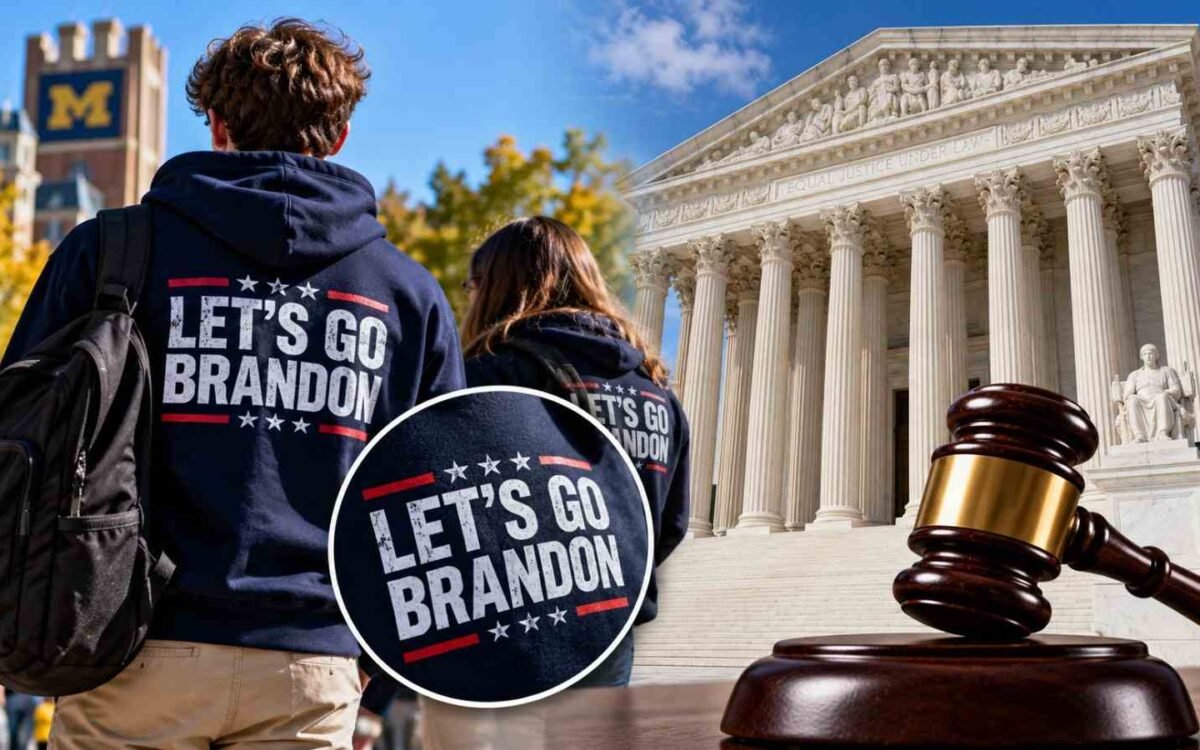
WASHINGTON — The U.S. Supreme Court has declined to hear a First Amendment dispute involving two Michigan middle school students who were barred from wearing “Let’s Go Brandon” sweatshirts at school.
The justices’ decision on October 5 leaves in place a lower-court ruling that sided with the Michigan school district. The case had raised an important constitutional question: Can a public school restrict political expression when the message uses a phrase that officials consider a coded form of profanity?
The Supreme Court rejected the appeal without hearing oral arguments, meaning the lower-court decision remains controlling in the dispute.
What Happened at the Michigan School?
The controversy began after two brothers attending Tri County Middle School in Howard City, Michigan, wore sweatshirts displaying the phrase “Let’s Go Brandon.”
Their mother had purchased the sweatshirts for them as Christmas gifts. School officials subsequently told the students to remove the clothing because administrators considered the slogan vulgar and inappropriate for the school environment.
The family argued that the students were expressing a political opinion and that preventing them from wearing the sweatshirts violated their rights under the First Amendment.
The dispute eventually moved through the federal court system before reaching the Supreme Court.
Read More- Flydubai Co-Pilot Allegedly Planned to Crash Plane Into Ben Gurion Airport, Sources Say
Why “Let’s Go Brandon” Became Political
The phrase emerged in 2021 following a NASCAR race involving driver Brandon Brown.
During a televised interview after Brown’s victory, spectators were heard chanting an explicit insult aimed at then-President Joe Biden. A television reporter interpreted the crowd’s chant as “Let’s Go, Brandon,” apparently believing spectators were cheering for Brown.
The phrase quickly became a political slogan and was subsequently adopted by many conservatives as a euphemistic insult aimed at Biden.
Although the words themselves do not contain profanity, their widely understood political meaning became central to the Michigan legal dispute.
The Students’ First Amendment Argument
The students and their mother argued that the school had improperly treated political speech as vulgar expression.
Their attorneys maintained that the sweatshirt did not contain an actual swear word and that students should not lose constitutional protection simply because administrators interpreted a phrase as having an offensive meaning.
They also argued that allowing schools to characterize political messages as vulgar could give school officials excessive discretion to suppress speech they dislike or find controversial.
That argument placed the dispute within the broader debate over the constitutional rights of students in public schools.
What Did the Lower Courts Decide?
The federal district court sided with the school district, concluding that the school could reasonably treat the phrase as vulgar in the school environment.
The case then went to the 6th U.S. Circuit Court of Appeals, which upheld the lower court’s decision in a divided ruling.
The majority concluded that the phrase’s commonly understood meaning allowed school officials to classify it as vulgar even though the actual words printed on the sweatshirt were not themselves profane.
One judge disagreed with the majority.
The dissent argued that political expression should receive strong First Amendment protection and questioned whether a school should be permitted to censor a message merely because it uses coded or indirect language.
Why the Supreme Court Case Mattered
The case attracted attention because it sits at the intersection of student free speech, political expression and school authority.
The Supreme Court has previously recognized that students do not automatically lose their constitutional rights when they enter a public school.
At the same time, the court has also recognized that schools have greater authority to regulate certain types of student expression, particularly speech that is considered vulgar, lewd or disruptive.
The Michigan dispute asked where that boundary should be drawn when political speech is expressed through a euphemism.
Supreme Court Declines to Intervene
The Supreme Court’s decision not to hear the case means the justices will not issue a nationwide ruling specifically addressing the “Let’s Go Brandon” sweatshirt dispute.
Instead, the 6th Circuit’s ruling remains in effect for the parties involved.
The Supreme Court’s decision also means that the broader constitutional question remains largely unresolved at the national level: how far schools can go in restricting political messages that are not explicitly obscene but are widely understood as substitutes for profanity.
There were no noted dissents from the Supreme Court’s decision to deny review.
Political Clothing at the Center of the Dispute
Another issue raised during the case involved other political clothing worn by students.
The legal filings noted that some students had worn clothing supporting former President Donald Trump, including apparel associated with the “Make America Great Again” slogan, without facing the same type of disciplinary response.
The students’ side argued that this raised questions about whether political viewpoints were being treated consistently.
The school district, however, maintained that its concern was the allegedly vulgar meaning of the “Let’s Go Brandon” slogan rather than the political position it represented.
The Bigger First Amendment Debate
The dispute highlights a longstanding tension in American schools.
Public schools are expected to maintain an environment suitable for education, and administrators have authority to regulate certain forms of speech.
But schools are also public institutions where students retain constitutional rights.
The landmark Tinker v. Des Moines decision established that students have First Amendment protections at school, particularly when engaging in nondisruptive political expression. Later Supreme Court cases, however, have recognized circumstances in which schools can restrict student speech, including vulgar or disruptive expression.
The Michigan case tested how those principles apply to modern political slogans and coded language.
What the Decision Means for Students
For the Michigan students involved, the Supreme Court’s decision effectively ends their effort to obtain review of the lower-court ruling.
The school district’s position remains intact, and the lower courts’ determination that the phrase could be treated as vulgar in the school setting is undisturbed.
However, the Supreme Court’s refusal to take the case does not necessarily establish a new nationwide constitutional rule that all schools may ban “Let’s Go Brandon” clothing.
Instead, it leaves the existing lower-court judgment in place while avoiding a broader ruling on the issue.
Read More- Trump Takes Nebraska Campaign Stop as Republicans Fight to Hold Senate Seat
A Small Case With a Larger Constitutional Question
What began with two students wearing political sweatshirts ultimately became a case about the limits of free speech inside America’s public schools.
The dispute forced courts to consider whether political expression loses constitutional protection when its meaning is conveyed through euphemism or coded language.
The Supreme Court’s decision not to hear the appeal means that question remains open for future cases.
As political slogans increasingly find their way into school clothing, social media posts and student demonstrations, similar disputes could continue to test the boundary between a school’s responsibility to maintain an appropriate educational environment and students’ constitutional right to express political views.



1 comment