
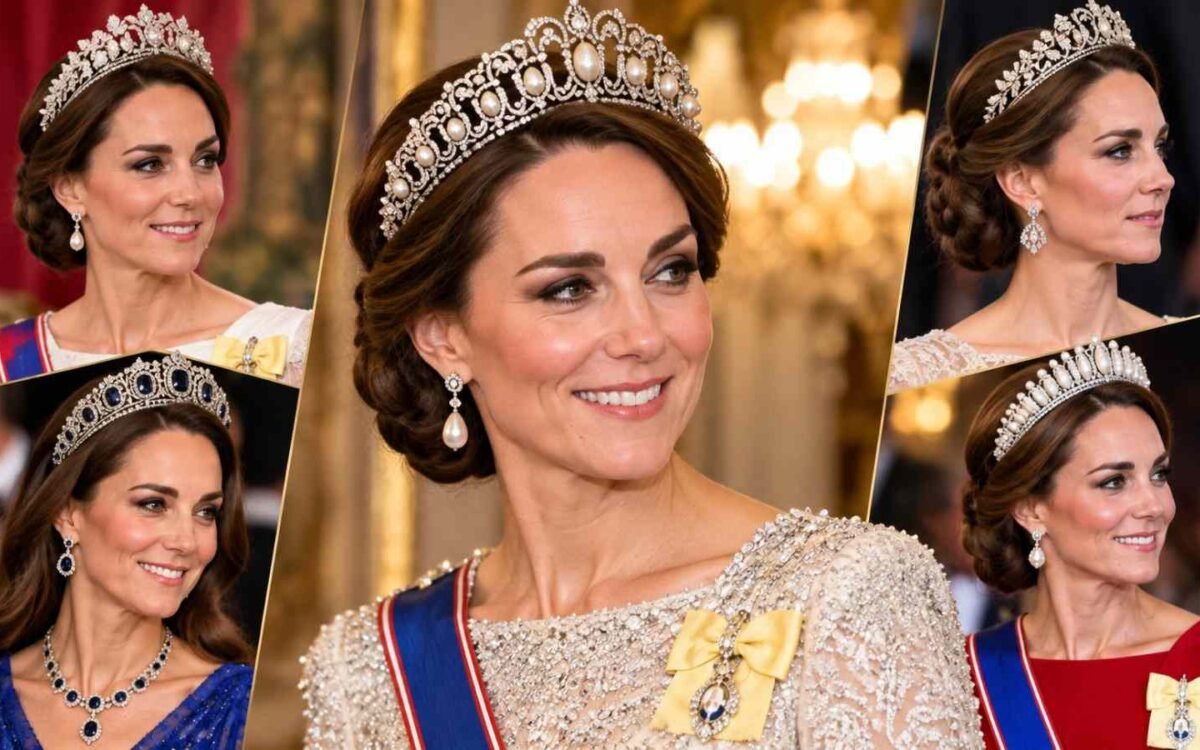
Few royal accessories attract as much attention as a diamond tiara. For Catherine, Princess of Wales, these historic headpieces do more than complete an evening gown. They connect her to generations of royal women, preserve centuries of tradition, and add meaning to some of the British monarchy’s most important occasions.
Since marrying Prince William in April 2011, Catherine has appeared in several remarkable tiaras, from the delicate Cartier Halo worn on her wedding day to the much-loved Cambridge Lover’s Knot and the rarely seen Strathmore Rose. Each appearance has offered royal watchers a glimpse into the history and craftsmanship of the royal jewellery collection.
Here are some of Kate Middleton’s most memorable tiara moments and the stories that make each one special.
1. The Cartier Halo Tiara: A Wedding Look That Made History
Catherine’s first tiara appearance remains one of her most recognisable fashion moments. On 29 April 2011, she married Prince William at Westminster Abbey wearing the Cartier Halo Tiara with her elegant ivory Alexander McQueen wedding gown.
The diamond headpiece was lent to Catherine by Queen Elizabeth II for the occasion. Its graceful design, formed by a series of diamond scrolls, complemented the lace detailing of her bridal ensemble without overwhelming it.
The tiara had a royal history of its own. It was made by Cartier in 1936 and was originally acquired for the future Queen Mother. It later became part of Queen Elizabeth II’s jewellery collection.
Catherine’s choice attracted international attention because it offered a refined alternative to the larger, more elaborate headpieces often associated with royal weddings. The combination of the historic tiara, her lace gown and the long bridal veil created an image that remains closely associated with the royal wedding.
2. The Cambridge Lover’s Knot Tiara: A Jewel With a Connection to Princess Diana
Among Catherine’s tiara appearances, the Cambridge Lover’s Knot has become particularly familiar to royal watchers. Its design features diamonds, pearls and distinctive arches, creating a striking silhouette that stands out at formal evening events.
Commissioned for Queen Mary in 1913, the tiara was inspired by an earlier royal design. It subsequently became associated with several members of the Royal Family, including Princess Diana, who wore it on numerous occasions.
That connection has given the headpiece additional significance for admirers of the late princess. Catherine’s decision to wear it has often prompted comparisons between two women whose lives have been closely connected to the Prince of Wales.
Catherine has worn the Lover’s Knot at diplomatic receptions and state banquets, pairing it with gowns in a variety of colours. Its elaborate structure works particularly well with formal hairstyles and evening dresses, making it one of her most recognisable royal accessories.
In March 2026, she wore the tiara at the state banquet held at Windsor Castle for Nigerian President Bola Tinubu and First Lady Oluremi Tinubu. Her emerald-green gown created a striking formal look, while the historic headpiece brought a familiar element of royal tradition to the occasion.
3. The Lotus Flower Tiara: A Delicate Design With a Royal Past
The Lotus Flower Tiara offers a different interpretation of royal glamour. Rather than relying on an especially tall or heavy silhouette, it features an elegant arrangement of diamond arches and lotus-inspired motifs.
Its history stretches back to the early twentieth century. The piece was originally created from jewellery belonging to Queen Mary before becoming a tiara. It later became associated with the Queen Mother and Princess Margaret.
Catherine wore the Lotus Flower Tiara in 2013, bringing the historic piece back into the public eye. She also wore it at a Buckingham Palace state banquet in October 2015, when she paired it with a red evening gown by Jenny Packham.
The headpiece has a softer appearance than the Lover’s Knot, making it well suited to gowns with clean lines or delicate embellishment. Its floral inspiration also distinguishes it from the more geometric designs seen in other royal tiaras.
For jewellery enthusiasts, the Lotus Flower is an example of how a historic piece can retain its character while looking appropriate for a modern royal wardrobe.
4. The Strathmore Rose Tiara: A Rare Royal Treasure Returns
One of Catherine’s most talked-about tiara appearances came in November 2023, when she wore the Strathmore Rose Tiara at a state banquet held in honour of South Korean President Yoon Suk Yeol and First Lady Kim Keon Hee.
The appearance was notable because the headpiece had rarely been seen in public for decades. Its design features diamond flowers inspired by wild roses, giving it a distinctly natural and romantic character.
The tiara was a wedding gift to Elizabeth Bowes-Lyon, later known as the Queen Mother, before her marriage to the future King George VI in 1923. It subsequently passed to Queen Elizabeth II.
Catherine paired the tiara with a white Jenny Packham gown featuring gold detailing. The combination highlighted the floral design while keeping the overall look elegant and understated.
The return of the Strathmore Rose was significant for royal jewellery fans because it brought renewed attention to a piece that had remained largely out of public view. It also demonstrated that the royal collection contains historic items beyond the small group of familiar tiaras regularly seen at state occasions.
5. Queen Victoria’s Oriental Circlet: A Dramatic Display of Royal Heritage
In December 2025, Catherine wore Queen Victoria’s Oriental Circlet Tiara at a state banquet held at Windsor Castle in honour of German President Frank-Walter Steinmeier.
The headpiece is among the more distinctive designs associated with the royal collection. It was created for Queen Victoria in the nineteenth century under the direction of Prince Albert and features an intricate arrangement of diamonds and ruby elements.
Its design reflects the artistic tastes and royal symbolism of the period in which it was created. The Oriental Circlet is also notable for its size and elaborate construction, making it a particularly dramatic choice for a formal state banquet.
Catherine’s appearance brought renewed attention to a historic jewel that is less familiar to the general public than the Lover’s Knot. Wearing such a distinctive piece also demonstrated the variety of styles available within the royal jewellery collection.
For royal fashion followers, the moment was a reminder that Catherine’s formal wardrobe is not limited to contemporary designers and modern accessories. Historic jewellery continues to play an important role in the visual language of royal events.
Read More –
Kate Middleton’s Wardrobe Staples: 6 Pieces She Wears on Repeat
Why Catherine’s Tiara Choices Continue to Fascinate Royal Watchers
A royal tiara is rarely just another accessory. The pieces worn by the Princess of Wales carry histories linked to monarchs, royal weddings, diplomatic occasions and earlier generations of the Royal Family.
The Lover’s Knot attracts attention because of its association with Princess Diana and its continued place in Catherine’s formal wardrobe. The Cartier Halo is inseparable from her wedding day, while the Strathmore Rose stands out because of its rarity. The Lotus Flower offers a more delicate design, and the Oriental Circlet showcases a more elaborate side of royal jewellery.
The occasions on which these pieces appear also matter. State banquets and diplomatic receptions provide opportunities for the monarchy to display historic objects while welcoming international guests. A tiara can therefore become part of a broader story involving heritage, ceremony and royal representation.
Catherine’s approach has also helped keep these jewels relevant to a modern audience. By wearing historic pieces alongside gowns from contemporary designers, she brings attention to their craftsmanship without changing their essential character.
A Modern Princess Wearing Centuries of Royal History
Catherine, Princess of Wales, has worn a relatively small selection of tiaras compared with the extensive history of the British royal collection. Yet her appearances have created some of the most memorable images of her royal life.
From her 2011 wedding to major diplomatic banquets, each headpiece has offered a different combination of personal significance, historic design and formal elegance. The jewellery tells stories that reach beyond fashion, connecting Catherine’s public role with the women who wore these pieces before her.
As future royal occasions bring more opportunities to see these historic jewels, interest in Catherine’s tiara collection is likely to continue. For many royal watchers, the fascination lies not simply in the diamonds and pearls, but in the history each tiara carries—and the way a new generation of royal women brings that history into the present.
Editorial note: This article is an original overview of Catherine’s notable tiara appearances, based on published reporting about the royal jewellery collection and her public engagements.
1 comment