
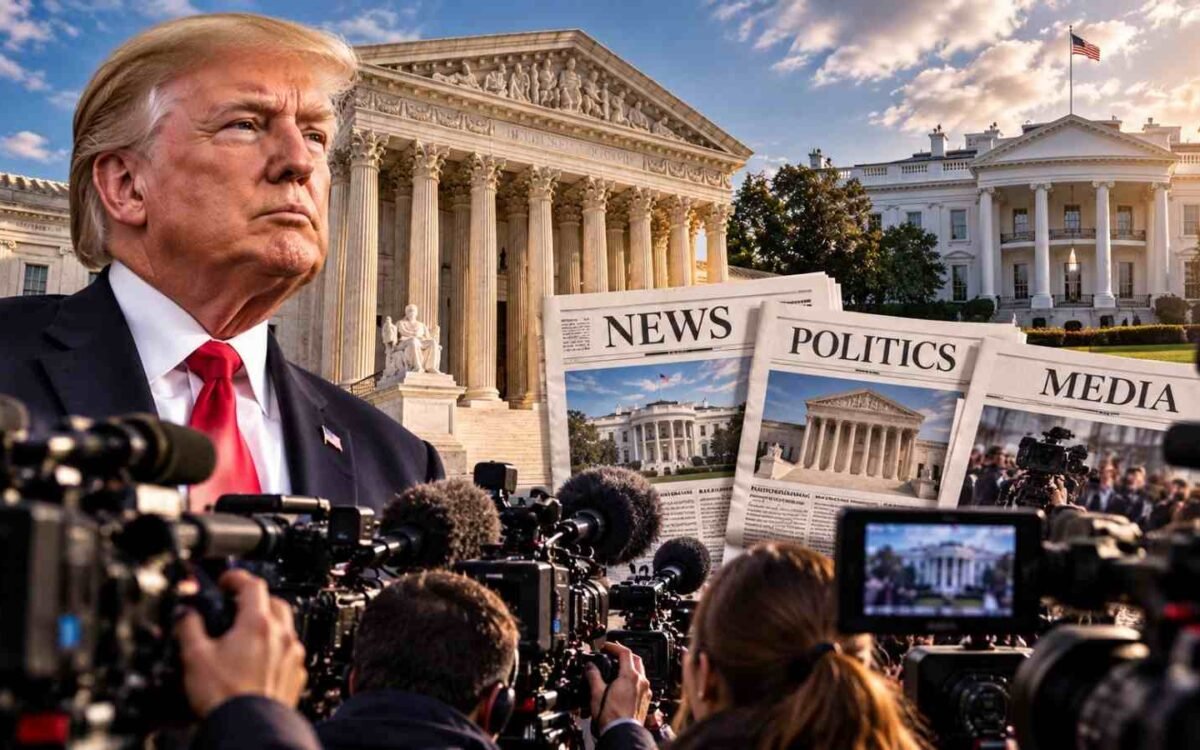
The legal battle between the Trump administration and three major news organizations has returned to federal court, with CNN, MS NOW and POLITICO seeking continued protection from a White House ban that they argue violates press freedom.
The dispute began in September when President Donald Trump announced that reporters from the three organizations would no longer be permitted on White House grounds.
Trump accused the outlets of producing what he called “fake news” and criticized their coverage of his administration. The organizations responded by taking the dispute to court, arguing that the administration had retaliated against them because of the content of their reporting.
A federal judge subsequently ordered the White House to restore their access temporarily.
Now, nearly three weeks after the original ban, the case has reached another important stage.
U.S. District Judge Timothy Kelly is considering whether the temporary protection should be extended while the broader lawsuit continues.
Why the News Organizations Are Back in Court
The latest hearing focuses on whether CNN, MS NOW and POLITICO should receive longer-term protection from the administration’s attempt to remove their White House press access.
The organizations argue that allowing the ban to return would expose their journalists to continued retaliation based on their reporting.
Their attorneys describe the government’s actions as a form of viewpoint discrimination, arguing that the administration cannot punish journalists simply because it dislikes their coverage.
The case therefore reaches beyond the individual organizations involved.
At its center is a broader constitutional question: How much authority does a president have to control which news organizations receive access to the White House?
How the Dispute Began
The confrontation escalated in September when Trump announced that CNN, MS NOW and POLITICO would be barred from White House grounds.
Trump argued publicly that the organizations should not continue receiving access while, in his view, publishing inaccurate and negative coverage of his presidency.
The administration later presented national security arguments for the restrictions.
The news organizations challenged the decision in federal court, arguing that the ban was retaliation for constitutionally protected journalism.
Their lawsuit cited both the First Amendment and due process protections.
The administration, meanwhile, maintained that access to the White House is not an unlimited right and that the president has authority to determine access to areas where security and space are limited.
Read More – Kate Middleton’s Wardrobe Staples: 6 Pieces She Wears on Repeat
Judge Timothy Kelly Previously Ordered Access Restored
The first major courtroom victory for the three organizations came on September 24.
Judge Timothy Kelly ordered the Trump administration to immediately restore the journalists’ White House access and temporarily blocked enforcement of the ban for 14 days.
Kelly said the organizations had met the legal threshold for emergency relief and found that the revocation of their credentials likely violated constitutional due process protections.
He also rejected the administration’s initial argument that national security justified the restrictions, saying the record did not provide sufficient factual support for that explanation.
The judge noted that Trump himself had publicly described the media organizations in terms related to their reporting rather than presenting national security as the original reason for the ban.
The Return to the White House Was Not Completely Smooth
Even after Kelly issued his order, the three organizations did not immediately regain normal access.
On the morning the judge ordered the restoration, journalists from CNN, MS NOW and POLITICO were initially still prevented from entering.
The organizations contacted the court and complained that the administration had not immediately complied with the ruling.
Eventually, the White House restored access.
The episode added another layer to an already unusual confrontation between the executive branch and major news organizations.
What the Administration Is Arguing
The Trump administration’s legal position is substantially different from that of the news organizations.
Justice Department lawyers have argued that access to the White House is a privilege rather than an absolute constitutional right.
They have also argued that the administration has legitimate concerns about information published by the outlets, including reports that officials characterize as involving classified material or national security issues.
The government therefore disputes the idea that the ban was simply punishment for unfavorable coverage.
Its position is that the president must retain significant authority over access to a highly secure government facility.
That argument is now being tested in court.
The News Organizations Say the Ban Was Retaliation
CNN, MS NOW and POLITICO take the opposite position.
Their attorneys argue that the timing and public statements surrounding the ban demonstrate that the restrictions were connected to the content of their journalism.
The organizations say that allowing a president to remove reporters because of unfavorable coverage could have a chilling effect across the media industry.
Their argument is not simply about three press credentials.
They contend that the case concerns the ability of journalists to report independently on the presidency without worrying that critical coverage could result in losing access.
That makes the case potentially significant for news organizations beyond the three plaintiffs.
The First Amendment Question
The First Amendment provides protections for freedom of speech and freedom of the press.
But that does not mean journalists automatically have unrestricted access to every government location or every presidential event.
The White House has always had to impose some limits because of security, space and logistics.
The legal question is therefore more complicated.
The issue is whether the administration can exclude particular news organizations because of their reporting or viewpoints after establishing a system in which journalists receive official access.
Legal experts cited by Reuters previously said the government’s position could face significant difficulties if the evidence shows that the outlets were targeted because of unfavorable coverage.
The Case Also Involves Due Process
The judge’s earlier decision focused heavily on due process.
The three organizations argued that their press passes were revoked without adequate notice or a meaningful opportunity to challenge the decision.
Kelly agreed that the outlets had shown a likelihood of success on that issue when he issued the temporary restraining order.
That means the case is not solely about freedom of the press.
It also involves the procedures the government must follow before removing journalists from an established press-access system.
A Previous Trump Administration Case Is Also Relevant
Judge Kelly has particular experience with White House press-access disputes.
During Trump’s first presidency, Kelly blocked the administration from revoking the press credentials of CNN reporter Jim Acosta.
That earlier case has become relevant to the current dispute because it involved questions about whether the government had acted fairly and transparently in removing a journalist’s access.
The current case could therefore become another important chapter in the courts’ examination of presidential authority over White House press access.
Other Media Organizations Have Entered the Debate
The dispute hhttps://www.facebook.com/reel/1801816230821036/?s=fb_shorts_profile&stack_idx=0as also attracted support from organizations outside CNN, MS NOW and POLITICO.
Press freedom groups and other news organizations have filed legal arguments supporting the three outlets.
The Associated Press, among others, has urged the court to protect access, reflecting concerns that the outcome could affect the broader relationship between the White House and the press.
The case has therefore developed into a larger debate about how presidents interact with journalists during periods of political conflict.
The Media Pool Has Also Been Affected
The dispute has produced consequences beyond the three organizations directly involved.
CNN is part of the rotating television pool responsible for recording and distributing video from certain presidential events.
Following the ban, other major networks temporarily declined to participate in the pool in a show of solidarity.
That created an unusual situation in which journalists could be present at presidential events but television coverage was affected by the dispute over who was permitted to participate.
The issue became particularly visible during high-profile diplomatic events in Washington.
Why the Timing Matters
The courtroom battle comes at a particularly significant moment in American politics.
The November 3 midterm elections are approaching, while the administration is dealing with major international and domestic issues.
The White House press corps is responsible for covering presidential decisions involving foreign policy, national security, the economy and other areas of public importance.
That makes the question of media access especially consequential.
The case could determine whether the three outlets continue to have routine access to the White House while their lawsuit proceeds.
What Judge Kelly Could Decide
The immediate question is whether Judge Kelly will grant longer-term protection to CNN, MS NOW and POLITICO while the lawsuit moves toward a final decision.
If he does, the administration would likely remain unable to enforce the original ban during the litigation.
If the court declines to extend the protection, the outlets could face renewed restrictions while the broader constitutional arguments continue.
The judge has not yet issued a final ruling on the First Amendment claims.
That means the central legal dispute remains unresolved.
The Larger Issue: Presidential Power and Press Access
The case is ultimately about more than three media companies.
Every modern president has dealt with journalists who criticize or challenge the administration.
Presidents also have legitimate security concerns and must control access to sensitive locations.
At the same time, the press plays a central role in informing the public about presidential decisions.
The difficult legal question is finding the boundary between those competing interests.
If a president can remove journalists because their reporting is unfavorable, critics argue that it could weaken independent oversight.
If the White House has no ability to restrict access under any circumstances, the government argues that it could create serious security and operational problems.
The court must therefore consider where that boundary lies under the Constitution.
What Happens Next?
For CNN, MS NOW and POLITICO, the immediate goal is clear: keep their journalists protected from another White House ban while the lawsuit continues.
For the Trump administration, the objective is to preserve presidential authority over White House access and defend the reasons it has given for restricting the three outlets.
The judge’s eventual decision could influence how the White House manages press credentials for the remainder of Trump’s presidency.
It could also become part of a broader body of legal precedent concerning presidential control over access to government facilities.
For now, the reporters are back, but the legal fight is far from finished.
The next ruling will determine whether that access becomes a temporary victory or remains protected for the duration of the case.
And beyond CNN, MS NOW and POLITICO, the outcome could help define a much bigger question in Washington: how far can a president go when controlling access to journalists who cover the White House?

1 comment