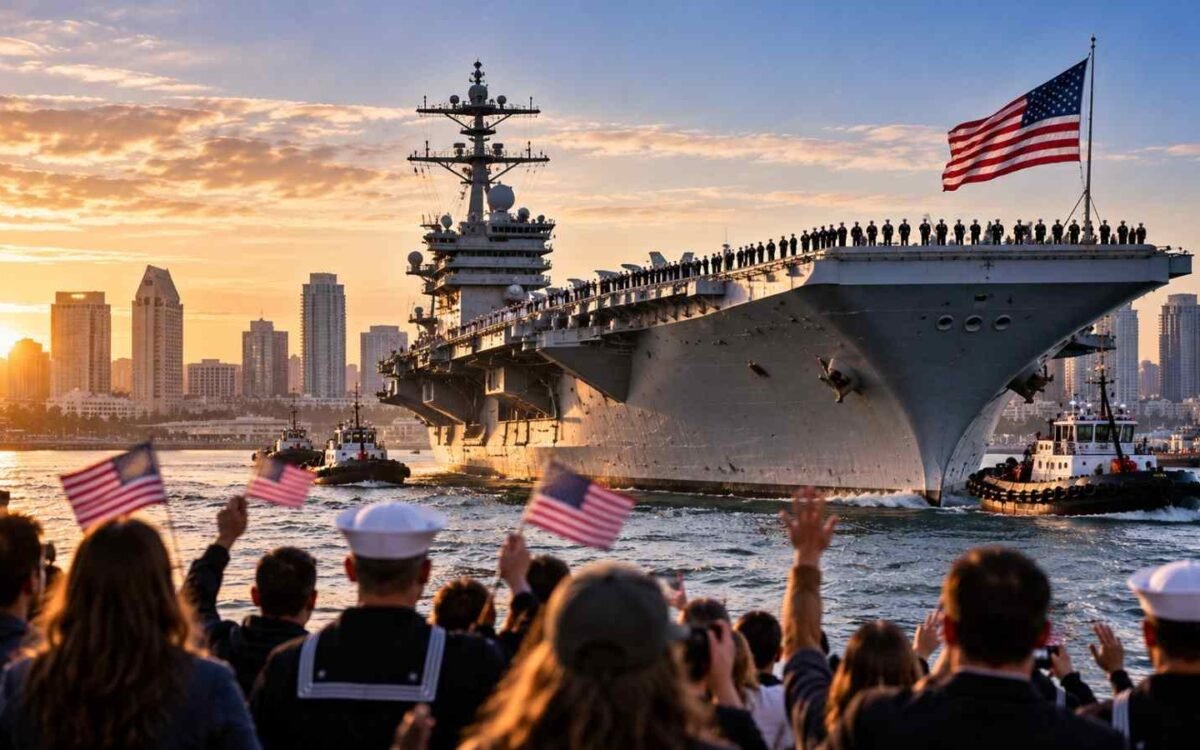
The USS Abraham Lincoln is finally returning to San Diego after one of the longest and most demanding deployments in the modern history of the U.S. Navy, bringing thousands of sailors and Marines home after months of combat operations, extended time at sea and growing concerns about conditions aboard the carrier.
The Nimitz-class aircraft carrier is scheduled to reach its home port in San Diego on Thursday, October 8, marking the end of a deployment that lasted roughly 321 days.
Even more striking, the Lincoln spent 265 consecutive days without a port call, setting a modern record for the length of time a U.S. aircraft carrier remained continuously at sea.
The return closes a remarkable chapter for the carrier and its roughly 5,000 sailors while also raising difficult questions about the human cost of prolonged military deployments.
A Deployment That Changed Dramatically
The USS Abraham Lincoln left Naval Station San Diego on November 21, 2025.
The carrier was initially headed toward the Pacific, but its mission changed dramatically as tensions involving Iran escalated.
The Lincoln was redirected toward the Middle East and eventually became part of U.S. military operations after the United States and Israel launched strikes against Iran on February 28, 2026.
The carrier and its accompanying strike group subsequently played a significant role in combat operations under the Trump administration’s Operation Epic Fury.
What began as a conventional deployment therefore evolved into a prolonged wartime mission.
265 Days Without a Port Call
Perhaps the most remarkable statistic from the deployment is the amount of time the Lincoln spent continuously at sea.
The carrier went approximately 265 days without a port visit.
For sailors, that meant months away from family, limited opportunities to leave the ship and increasing pressure on the vessel’s personnel and equipment.
The ship eventually made a port call in Thailand in September, providing the crew with a rare opportunity to step ashore after more than eight months at sea.
The length of the deployment was far beyond the roughly seven-month period normally associated with many carrier deployments.
Read More- CNN, MS NOW and POLITICO Return to Court as Trump White House Media Fight Intensifies
The Carrier Was at the Center of the Iran War
The Lincoln’s mission became particularly important after the outbreak of war with Iran.
Aircraft operating from the carrier were involved in combat missions, while the strike group provided a major component of U.S. naval power in the region.
According to the Presidential Unit Citation presented to the strike group, the Lincoln and its accompanying forces carried out 3,693 combat missions, launched hundreds of Tomahawk cruise missiles and engaged Iranian military targets during the operation.
The carrier’s return therefore represents more than the end of a routine deployment.
It marks the conclusion of a mission that placed the ship at the center of a major military conflict.
Hegseth Visits the Lincoln Before Its Return
Defense Secretary Pete Hegseth travelled to the USS Abraham Lincoln on Wednesday, October 7, just one day before the carrier’s scheduled arrival in San Diego.
During his visit, Hegseth praised the crew for completing what he described as an extraordinary mission.
He also announced that the Lincoln and its carrier strike group would receive the Presidential Unit Citation, one of the U.S. military’s highest unit-level awards for extraordinary performance in combat.
The award recognized the strike group’s combat operations and its role in the conflict with Iran.
Hegseth also pushed back against descriptions of the Lincoln as a symbol of low morale or dysfunction.
Instead, he emphasized the crew’s ability to continue operating despite the difficulties associated with such a prolonged deployment.
Reports of Supply Shortages Created Controversy
The successful combat mission was accompanied by a separate controversy.
During the summer, reports emerged describing shortages aboard the carrier involving food, personal hygiene products and other supplies.
Some sailors and their families also raised concerns about the psychological impact of spending such a long period at sea.
The Navy initially defended the ship’s ability to maintain adequate supplies and operational readiness.
Officials later acknowledged that combat conditions and difficulties with resupply had affected the availability of some items.
Acting Navy Secretary Hung Cao said that meal choices had been temporarily reduced because resupply opportunities were limited, although he maintained that sailors continued to receive nutritionally adequate meals.
Mental Health Concerns Added to the Pressure
The deployment also drew attention because of reports concerning the mental health of sailors.
In September, Acting Navy Secretary Hung Cao told lawmakers that eight service members within the Lincoln carrier strike group had attempted suicide during the extended deployment.
No deaths were reported from those attempts.
The disclosures intensified concerns about the psychological burden created by unusually long periods at sea and the lack of regular port visits.
Military leaders have emphasized that the figure must be viewed in context, while acknowledging that long deployments can place significant stress on service members.
The issue has nevertheless become an important part of the discussion surrounding the Lincoln’s return.
Families Have Waited Months to See Their Loved Ones
Behind the military statistics are thousands of families who have spent much of the past year waiting for sailors to return.
The carrier left San Diego in November 2025.
For many family members, the scheduled October 2026 homecoming represents the first opportunity in months to return to a normal family routine.
The prolonged deployment also meant that birthdays, holidays and other important moments were experienced from thousands of miles away.
That is one reason the return to San Diego carries significance beyond the military mission itself.
The Navy Defends the Mission
Despite the controversies, military officials have strongly defended the Lincoln’s performance.
The Presidential Unit Citation reflects the Navy’s assessment that the carrier strike group achieved an exceptional level of combat effectiveness.
According to the citation, the group conducted thousands of combat missions and successfully engaged numerous Iranian military assets.
Hegseth similarly argued that the crew’s ability to complete the mission under difficult circumstances demonstrated the resilience of the U.S. Navy.
The Pentagon’s position is therefore that the hardships experienced during the deployment should not overshadow the carrier’s operational achievements.
The Lincoln Was Eventually Relieved
The Navy ultimately arranged for another aircraft carrier, the USS George Washington, to replace the Lincoln in the Middle East.
The George Washington moved into the region as the Lincoln began its journey home in late August.
The Lincoln then made its way through the Indo-Pacific before continuing toward Southern California.
The Thailand port call in September was particularly significant because it followed an unusually long period without a visit to a foreign port.
Another U.S. Carrier Has Also Faced an Extraordinary Deployment
The Lincoln’s experience is part of a broader pattern involving increasingly long U.S. Navy carrier deployments.
Earlier in 2026, the USS Gerald R. Ford returned home following an even longer deployment of approximately 326–327 days.
That deployment also attracted attention because of the enormous demands placed on sailors and the ship.
The Lincoln therefore becomes the latest example of how extended global military operations are putting additional pressure on America’s carrier fleet.
Why Long Carrier Deployments Matter
Aircraft carriers are among the most powerful military platforms in the world.
But their effectiveness depends on thousands of people working continuously under demanding conditions.
A carrier is effectively a floating city, complete with aircraft, weapons systems, medical facilities, kitchens, engineering spaces and living quarters.
Keeping such a vessel operational for months at a time requires a complex global supply network.
When combat operations limit access to ports or disrupt supply routes, the pressure on sailors increases.
The Lincoln’s deployment demonstrated both the strategic value of carrier groups and the challenges associated with keeping them at sea for extraordinary periods.
The Return Is a Relief — But Questions Remain
The arrival of the USS Abraham Lincoln in San Diego will undoubtedly be celebrated by sailors, families and supporters.
But the homecoming is unlikely to end questions about how the deployment was managed.
The reports of supply shortages, mental-health difficulties and unusually long periods without port access have already generated calls for greater scrutiny.
Some lawmakers have said they intend to continue examining the conditions aboard the carrier even after the sailors return home.
That means the Lincoln’s story may continue long after it reaches the dock.
A Historic Homecoming
For the sailors aboard the USS Abraham Lincoln, however, the immediate priority is much simpler.
They are coming home.
After leaving San Diego in November 2025, spending months in the Middle East and supporting combat operations against Iran, the crew is finally returning to its home port.
The carrier’s deployment lasted approximately 321 days, while its uninterrupted period at sea reached 265 days.
Those figures alone demonstrate how extraordinary the mission became.
The crew will return with a Presidential Unit Citation, recognition for an intense combat mission and the experience of one of the most demanding deployments in recent U.S. naval history.
But for the families waiting in San Diego, the most important part of the story may be much less complicated:
The USS Abraham Lincoln is coming home.