
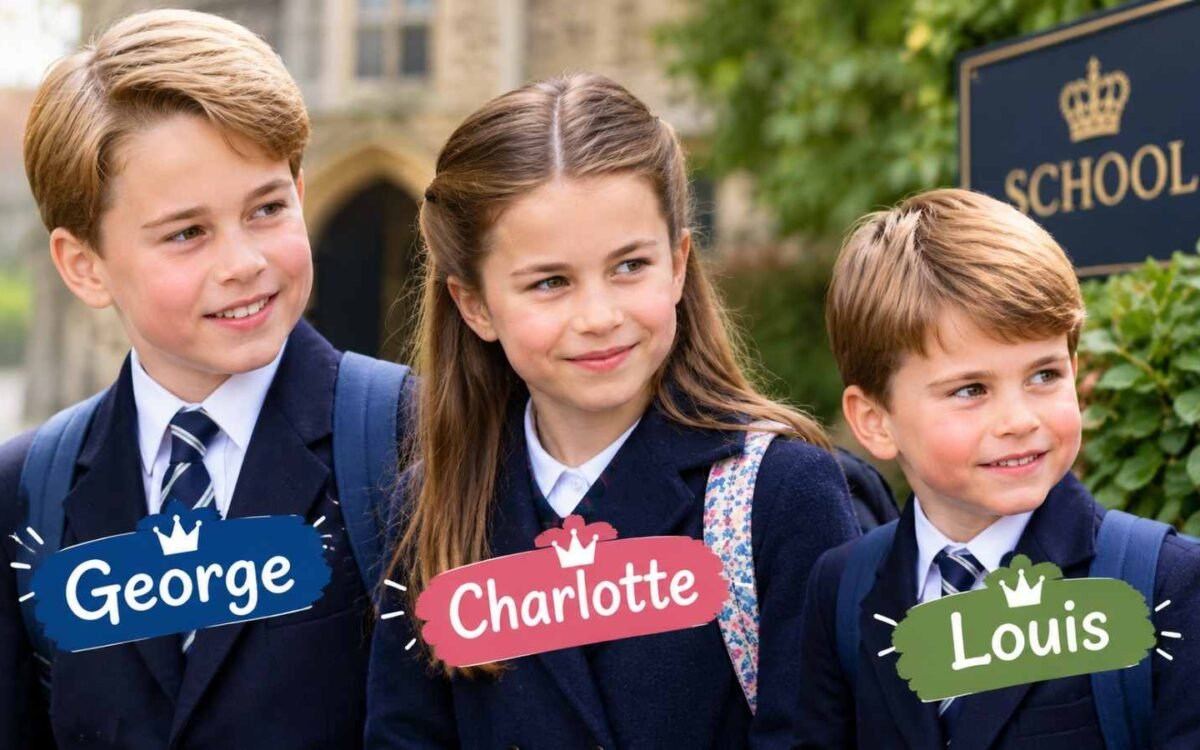
Prince William and Kate Middleton’s children have a more ordinary way of identifying themselves in the classroom—and the reason behind their school names reveals an interesting royal family tradition.
Prince George, Princess Charlotte and Prince Louis are among the most recognisable young members of the British Royal Family. Their official titles reflect their place in the monarchy, but when it comes to everyday school life, things are considerably less formal.
The three children of the Prince and Princess of Wales are reportedly known as George Wales, Charlotte Wales and Louis Wales when a surname is required at school. The name is connected to their parents’ titles and follows a tradition that Prince William and his brother, Prince Harry, also observed during their school years.
The detail may seem surprising, but it offers a glimpse into how the royal family balances centuries-old traditions with the practical realities of childhood.
Why Do Prince George, Princess Charlotte and Prince Louis Use the Surname Wales?
The explanation begins with their parents.
Following Queen Elizabeth II’s death in September 2022, King Charles III became monarch and Prince William was given the title Prince of Wales. Catherine became the Princess of Wales, and their children’s connection to the Wales title was reflected in the names they could use in everyday settings.
Consequently, when a surname is needed at school, the siblings are reported to use Wales rather than their full royal titles.
The arrangement is not a sudden departure from royal tradition. Members of the Royal Family do not always use a conventional surname in daily life. Their titles often identify them, while a family or territorial name can be used when a surname is required.
For George, Charlotte and Louis, Wales provides a shared family name that is simpler to use in an ordinary school environment.
The Royal Children Previously Used the Name Cambridge
Before William became Prince of Wales, he and Catherine were known as the Duke and Duchess of Cambridge. Their children were consequently associated with the surname Cambridge in school settings.
The transition from Cambridge to Wales followed the change in their parents’ titles in 2022. It illustrates how royal names can change in everyday use when a family’s official position changes, even though the children themselves remain the same.
For many families, a surname remains constant throughout life. In the Royal Family, however, a title can influence the name used for school, public duties and other situations where a conventional surname is useful.
The children’s reported school names therefore reflect a change in royal status rather than a change to their identities.
Prince William and Prince Harry Followed the Same Tradition
George, Charlotte and Louis are not the first royal children to use Wales as a surname.
Prince William and Prince Harry were known as William Wales and Harry Wales during their younger years, when their father, now King Charles III, held the title Prince of Wales. The brothers also used Wales during their military careers.
This family precedent helps explain why the names used by William’s children are not unusual within royal circles.
The tradition allows royal family members to use a recognisable family connection without relying on a lengthy formal title in every setting. It also demonstrates how royal naming conventions can be shaped by inherited titles as well as family relationships.
For George, who is expected to have a prominent public role in the future, the name Wales is already part of the way his family navigates the line between public identity and everyday life.
What Are the Children’s Official Royal Titles?
Although the siblings reportedly use shorter names at school, their formal royal titles remain different from the names used in the classroom.
- Prince George of Wales is the eldest child of William and Catherine and is second in line to the British throne.
- Princess Charlotte of Wales is the couple’s second child and is third in the line of succession.
- Prince Louis of Wales is their youngest child and is fourth in the line of succession.
These positions reflect the current line of succession and the children’s place in the Royal Family. Their school names do not change their titles or their position in the succession.
It is also useful to distinguish the surname Wales from the Royal Family’s technical family surname, Mountbatten-Windsor. The royal family’s naming conventions are more complicated than those of most families, and the name used in a school setting does not necessarily represent the surname used for every formal or legal purpose.
Prince George Has Started a New Chapter at Eton College
The naming detail has attracted renewed attention as Prince George begins a new stage of his education.
In September 2026, George started at Eton College, the prestigious Berkshire school attended by his father and uncle. His move marked a significant milestone as he entered his teenage years and began a different phase of school life.
The school has a long history and is known for its academic traditions. William’s experience there also gives George a family connection to the institution, although the younger prince will have his own experiences as he adjusts to a new environment.
Read More- 7 Signs Kate Middleton Is Preparing for Her Future Role as Queen
Meanwhile, Princess Charlotte and Prince Louis continue their education at Lambrook School in Berkshire, where the three siblings previously studied together. The children are therefore at different stages of their school journeys, even as they share the same reported school surname.
For George, using a simpler name in everyday school settings may help separate the formality of his royal position from ordinary interactions with classmates. It does not remove the public interest surrounding him, but it illustrates the practical ways the family navigates his education.
Why the Royal Family Does Not Always Use a Conventional Surname
The British Royal Family’s naming system can be confusing because titles, house names and surnames serve different purposes.
The name Windsor became associated with the Royal Family in 1917, when King George V established it as the family name. In 1960, Queen Elizabeth II and Prince Philip decided that their descendants who needed a surname could use Mountbatten-Windsor, combining Windsor with Philip’s family name.
However, members of the Royal Family who hold princely titles do not always need to use that surname in everyday life. A territorial title can instead provide a practical name when one is required.
Other members of the family have followed similar conventions. Princess Beatrice and Princess Eugenie, for example, have been associated with the surname York, reflecting their father’s former title as Duke of York.
These examples show that the names used by royal children are not simply a matter of personal preference. They are also influenced by the family’s titles, traditions and the setting in which a name is being used.
A Small Detail That Offers a Glimpse of Royal Family Life
The names George Wales, Charlotte Wales and Louis Wales may sound ordinary, but the story behind them reflects the unusual circumstances in which the young royals are growing up.
Their titles place them among the most closely watched children in Britain, while their school lives require many of the same practical arrangements as those of other pupils. A shorter name can be used in the classroom, even as their formal identities remain tied to the monarchy.
For Prince William and Catherine, the challenge is to prepare their children for their future responsibilities while allowing them to experience childhood and education as normally as possible. The use of a shared surname is one small example of how royal tradition can adapt to everyday life.
The detail is also a reminder that the Royal Family’s naming conventions are more flexible than many people realise. A prince or princess may have a formal title, a family surname and a simpler name used in school or other everyday settings.
Ultimately, the names used by Prince George, Princess Charlotte and Prince Louis are not a secret identity or a dramatic change. They are part of a longstanding royal practice—one that connects the next generation of the monarchy with the experiences of their father and uncle while giving them a simpler way to navigate school life.
1 comment