
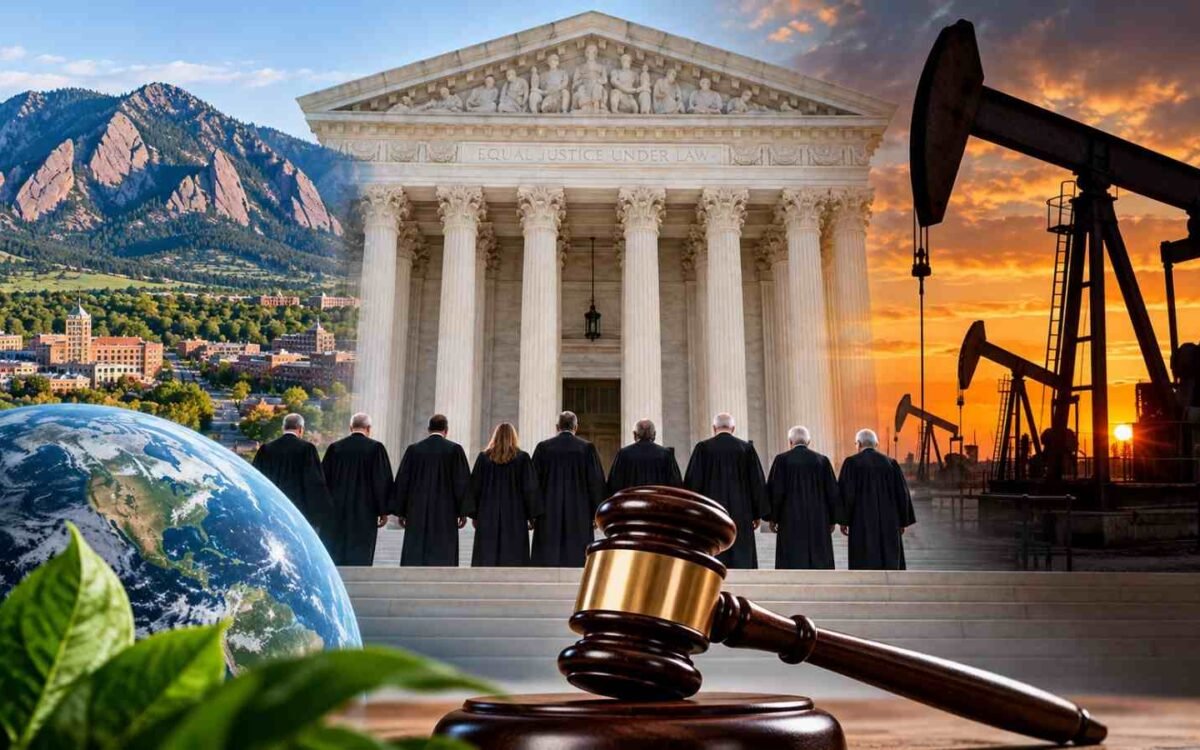
WASHINGTON — The U.S. Supreme Court has opened a closely watched legal battle over whether oil companies can be held financially responsible under state law for damage linked to climate change.
At the center of the case is a lawsuit brought by officials in Boulder, Colorado, against energy giants ExxonMobil and Suncor Energy. The companies are asking the nation’s highest court to prevent the case from moving forward, arguing that climate change and greenhouse-gas emissions are matters that fall under federal authority rather than state courts.
The Supreme Court heard arguments Monday as it began its new nine-month term. The case could have consequences well beyond Colorado because dozens of similar lawsuits have been filed by cities, counties and states across the United States.
Why Boulder Is Suing the Oil Companies
Boulder city and county officials accuse ExxonMobil and Suncor of contributing to climate change and misleading the public about the risks associated with fossil fuels.
The local governments are seeking compensation for costs they say have resulted from climate-related damage. Those expenses include infrastructure repairs, environmental protection, emergency response and other costs associated with the effects of a warming climate.
Boulder filed its lawsuit under Colorado state law, rather than relying on federal environmental statutes.
That distinction is at the heart of the Supreme Court dispute.
The oil companies argue that allowing state-law claims involving global greenhouse-gas emissions would effectively allow individual states and local governments to regulate conduct occurring across national and international borders.
ExxonMobil and Suncor Challenge the Case
ExxonMobil and Suncor have asked the Supreme Court to stop Boulder’s lawsuit from proceeding.
Their central argument is that federal law prevents state courts from handling claims involving interstate and international greenhouse-gas emissions.
The companies have pointed to the Clean Air Act and broader principles of federal authority. They argue that climate change is inherently a global issue and that allowing individual states to impose liability could create conflicting legal standards across the country.
The companies’ position has received support from the administration of President Donald Trump, which has argued that federal authority over air pollution prevents Boulder’s claims from proceeding under state law.
Boulder, however, maintains that its lawsuit falls within traditional state authority and that federal law does not eliminate its ability to seek damages under state law.
A Decision Could Affect Dozens of Other Cases
The stakes extend far beyond the dispute between Boulder and two energy companies.
According to Exxon and Suncor, nearly 60 state and local governments have brought similar lawsuits seeking billions of dollars from fossil-fuel companies.
Many of those cases involve allegations that energy companies knew about the potential consequences of greenhouse-gas emissions while failing to adequately inform the public.
A Supreme Court decision favorable to the oil companies could make it substantially harder for those lawsuits to continue.
On the other hand, if Boulder is allowed to proceed, other communities pursuing similar claims could receive an important legal pathway to continue their cases.
The Clean Air Act Question
One of the most important legal issues concerns the relationship between state environmental claims and the federal Clean Air Act.
ExxonMobil and Suncor contend that federal regulation of air pollution limits the ability of states to pursue climate-related claims involving emissions that cross state and national boundaries.
Boulder disputes that interpretation.
According to the Supreme Court case summary, Boulder argues that the Clean Air Act displaced earlier federal common-law approaches to interstate pollution and does not prevent its state-law claims from moving forward.
The justices must therefore consider how far federal authority extends and whether it prevents state courts from hearing lawsuits connected to global climate change.
Justice Samuel Alito Is Not Participating
Another notable element of the case is the absence of Justice Samuel Alito.
Alito has recused himself from the proceedings. His financial disclosures show holdings in several oil and gas companies, although he does not own shares in ExxonMobil or Suncor.
His recusal means the case will be decided by eight justices rather than the full nine-member court.
The court currently has a 6-3 conservative majority, although Alito’s absence could become significant depending on how the remaining justices divide.
Why the Case Matters for Local Governments
For communities dealing with wildfires, flooding, extreme heat, infrastructure damage and other climate-related costs, the case could determine whether state courts remain an avenue for seeking compensation from fossil-fuel companies.
Local governments argue that taxpayers should not necessarily have to shoulder the entire financial burden associated with climate-related damage.
The energy industry takes a very different position, warning that allowing these lawsuits to continue could expose companies to potentially enormous liability based on the worldwide consequences of greenhouse-gas emissions.
The legal battle therefore involves not only questions about climate change, but also the boundaries between state power, federal authority and corporate responsibility.
The Supreme Court’s Decision Is Still Months Away
Monday’s hearing does not immediately resolve the dispute.
The justices will consider the arguments before issuing their decision, which is expected by the end of June 2027.
Whatever the court ultimately decides, the ruling could become an important turning point in climate litigation across the United States.
A victory for ExxonMobil and Suncor could threaten the continuation of numerous state and local climate cases. A decision allowing Boulder’s lawsuit to proceed could give communities around the country greater opportunity to pursue similar claims.
A High-Stakes Test for Climate Litigation
The Boulder case places a fundamental question before the Supreme Court:
Can state and local governments use their own laws to seek compensation from fossil-fuel companies for climate-related damage, or is that issue controlled exclusively by federal law?
The answer could shape the future of climate litigation in America for years to come.
For now, the lawsuit remains alive, the justices have heard the arguments, and communities on both sides of the climate debate are waiting for the court’s decision.
The Supreme Court’s eventual ruling could determine whether Boulder’s case becomes the beginning of a broader wave of climate lawsuits—or the legal barrier that stops many of them in their tracks.


1 comment