
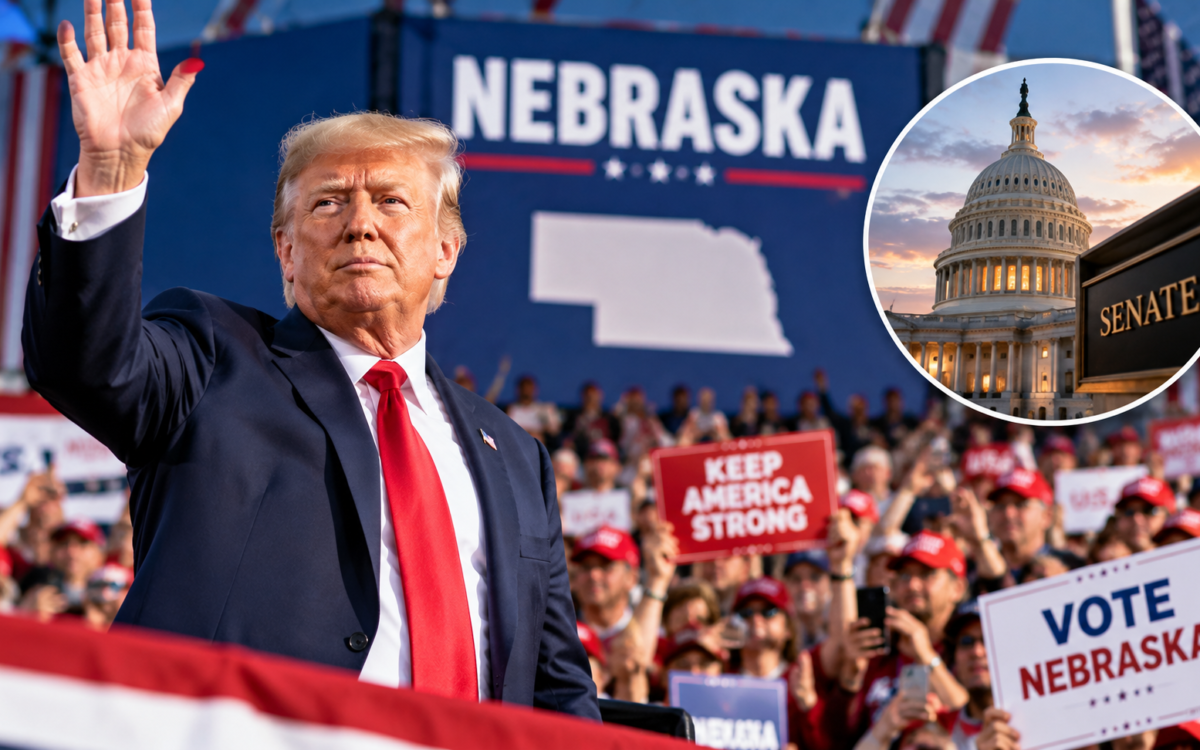
GRAND ISLAND, Nebraska — President Donald Trump is turning his attention to Nebraska as Republicans confront an unexpectedly competitive Senate race in one of the country’s traditionally strongest Republican states.
Trump is scheduled to campaign in Grand Island on Monday alongside Republican Sen. Pete Ricketts, making the Nebraska visit part of an aggressive campaign push ahead of the November 3 midterm elections.
The president’s appearance is intended to energize Republican voters and reinforce the party’s economic message at a time when concerns over inflation, fuel costs and the broader economy are becoming increasingly important to voters.
Why Nebraska Is Suddenly on the Political Map
Nebraska has long been considered reliable Republican territory.
Trump won the state by more than 20 percentage points in the 2024 presidential election, making the current Senate contest particularly noteworthy. Yet polling and campaign activity indicate that Democrats and their allies see an opportunity to challenge Republicans even in traditionally safe states.
Ricketts is seeking a full six-year Senate term after previously serving as governor and later being appointed and elected to fill the remainder of former Sen. Ben Sasse’s term.
His opponent is independent candidate Dan Osborn, a former labor leader who has attracted support from national Democrats while maintaining an independent political identity.
The contest has therefore become a test of whether Republican strength in Nebraska can withstand a broader national political shift.
Trump Wants Voters to See the Election as a Referendum
Trump has increasingly portrayed the 2026 midterm elections as a judgment on his administration.
Rather than treating the congressional races as separate contests, he has encouraged Republicans to think of him as effectively being on the ballot, making his economic record a central part of the campaign message.
That strategy allows Trump to use his considerable political following to boost Republican candidates in states where local races have become more competitive.
His Nebraska appearance is part of a broader 32-day campaign tour ahead of Election Day. Recent stops have included heavily Republican states such as Texas, Oklahoma, Alabama and Ohio.
Economic Concerns Could Complicate the Republican Message
The president’s campaign message emphasizes investment, manufacturing and economic growth.
But Republicans are campaigning in an environment where voters are increasingly concerned about the cost of everyday life.
Nebraska farmers and truckers, in particular, are dealing with significantly higher diesel costs, while inflation remains a major concern for consumers.
That creates a difficult political balancing act for Republicans: convincing voters that the administration’s economic policies are producing long-term gains while addressing frustration over prices in the short term.
Beef Imports Create Another Challenge
Agriculture is especially important in Nebraska, and Trump’s plans to increase beef imports have generated opposition among some ranchers.
Nebraska ranchers argue that additional foreign beef could put pressure on domestic producers at a time when the industry is already dealing with economic challenges.
Ricketts himself has criticized the administration’s approach, urging policymakers to find other ways to address high beef prices without putting additional pressure on American cattle producers.
The issue gives Democrats and Osborn another opening in a state where agricultural concerns can have significant political consequences.
Dan Osborn’s Independent Campaign
Osborn is running as an independent rather than as a traditional Democratic candidate.
That distinction could be important in Nebraska, where a Democratic Senate campaign faces an uphill battle because of the state’s Republican lean.
National Democrats have nevertheless backed Osborn’s effort, viewing the race as a potential opportunity to expand the Senate battlefield into territory that Republicans have traditionally considered secure.
Osborn has also criticized Ricketts over constituent outreach and other issues, attempting to present himself as an alternative to both established political parties.
The strategy mirrors independent campaigns developing in several traditionally conservative states during the 2026 election cycle.
Trump’s Political Standing Adds Pressure
Trump’s decision to campaign in Nebraska comes as Republicans face a difficult national political environment.
A Reuters/Ipsos poll cited by Reuters last month put Trump’s overall approval rating at 32%, while his approval among Republicans had also fallen from earlier levels.
For Republicans, the concern is that dissatisfaction with the president could affect congressional candidates even in states that strongly supported him in the presidential election.
That is one reason the president is spending considerable time campaigning in Republican strongholds rather than limiting his appearances to traditional swing states.
Nebraska Is Part of a Larger Republican Defense
The Nebraska contest is not occurring in isolation.
Republicans are defending a Senate majority while Democrats are attempting to make gains across the country.
Recent political analysis has shown Democratic candidates becoming more competitive in several states that have historically favored Republicans. That has forced the GOP to reconsider which Senate races can safely be treated as low-risk contests.
Nebraska is particularly notable because of the enormous margin Trump achieved there in 2024.
If a Republican Senate incumbent faces a serious challenge in such a state, it could signal that the national political environment is becoming increasingly difficult for the GOP.
Trump’s Broader Midterm Strategy
Trump’s campaign schedule reflects an effort to mobilize his core supporters and make Republican candidates’ races partly about his presidency.
The president has repeatedly urged Republicans to turn out and treat the election as a referendum on his administration.
His Nebraska visit follows appearances in other conservative states and comes roughly one month before voters head to the polls.
The strategy is straightforward: energize Republican voters, reinforce the administration’s economic message and prevent traditionally safe Republican seats from becoming vulnerable.
Read More- U.S. Supreme Court Takes Up Major Climate Fight Between Boulder and Big Oil
A Race Worth Watching
Ricketts remains the Republican candidate in a state where the GOP has historically enjoyed a major advantage.
But the presence of a competitive independent challenger has transformed what might normally have been a routine reelection campaign into a race receiving national attention.
For Democrats, winning Nebraska would represent a major breakthrough.
For Republicans, holding the seat would demonstrate that Trump’s political coalition remains strong enough to protect vulnerable incumbents even as the national environment becomes more challenging.
Trump’s visit to Grand Island is therefore about more than one Senate race.
It is an early test of whether the president can translate his personal political influence into votes for Republican candidates—and whether the GOP’s traditional advantage in deeply conservative states remains as strong as it once appeared.
With Election Day approaching, Nebraska is emerging as an unexpected battleground, making Ricketts versus Osborn one of the Senate contests to watch closely in the final weeks of the 2026 campaign.


2 comments